Your fuel bill can rise even when the car uses no more fuel per kilometre. You might also travel farther after a purchase because the route changed, rather than because vehicle efficiency improved on its own. To understand a record, separate fuel quantity, distance and price, then compare periods whose conditions can be explained.
This guide explains consumption calculations, recordkeeping and interpretation using hypothetical examples. It gives no mechanical diagnosis, maintenance or refuelling instructions, and quotes no current fuel price. Follow vehicle and fuel-station instructions in actual use, and record information only after stopping somewhere appropriate, never while driving.
Understand the unit before comparing numbers
Litres per 100 kilometres asks how much fuel corresponds to a fixed distance. A smaller value means less fuel for that distance. Kilometres per litre instead describes the distance associated with a fixed amount of fuel, so a larger value is preferable in that measure alone.
Do not compare numbers in different units before converting them. “Mine gives 12 and yours 8” is incomplete without units. For miles per gallon, identify the gallon type and the source definition rather than entering a number in an unexplained calculator and assuming a precise comparison.
The Hong Kong Electrical and Mechanical Services Department gives the calculation: litres used divided by kilometres travelled, multiplied by 100. Its record concerns comparable periods. Our examples use the arithmetic independently, not its sample figures or operational refuelling instructions.
Connect fuel with the correct interval
Record start and end dates, both distance-counter readings and the fuel attributed to that interval. The quantity must match the distance being calculated, not simply any receipt from the same date. If the fuel level differs between the interval's endpoints, fuel purchased does not necessarily equal fuel consumed.
Include a field describing the data method: a consistent purchase record with clear boundaries, a trip-computer reading or an incomplete estimate. Do not mix methods into one series without explanation. If a receipt or opening reading is missing, mark the interval incomplete rather than inventing a value to make the table tidy.
| Field | Why it matters | Common error |
|---|---|---|
| Start and end readings | Calculate distance within the interval | Using total odometer distance rather than its difference |
| Fuel attributed to the interval | Match litres to the same distance | Treating every purchase as immediate consumption |
| Unit | Distinguish L/100 km from km/L | Comparing numbers without units |
| Price and total cost | Separate price changes from consumption | Using money instead of litres in the formula |
| Usage notes | Explain differences between periods | Attributing every change to a fault |
Calculate consumption step by step
Assume a complete teaching record: the odometer changes from 20000 to 20400 kilometres, and 32 litres consumed are correctly attributed to that interval. Distance is 20400 − 20000 = 400 kilometres. Consumption is 32 ÷ 400 × 100 = 8 litres per 100 kilometres.
To express the same record in kilometres per litre, divide distance by fuel: 400 ÷ 32 = 12.5 kilometres per litre. These are two expressions of the same example, not two different performances. Keep the unit beside the result, including when sharing it.
Before accepting the calculation, check that distance is greater than zero, readings are ordered correctly and the quantity fits the record's context. An unusual result calls first for reviewing inputs, boundaries and units. A misplaced decimal is not evidence of a vehicle problem.
Why a simple average of rates can mislead
Suppose a second interval uses 54 litres over 900 kilometres. Its rate is 54 ÷ 900 × 100 = 6 litres per 100 kilometres. The simple average of 8 and 6 is 7, but this ignores that the second interval covers much more distance.
For the combined rate, first add fuel and distance: 32 + 54 = 86 litres and 400 + 900 = 1300 kilometres. The result is 86 ÷ 1300 × 100 ≈ 6.62 litres per 100 kilometres. Under the assumption that both intervals are complete, that is their combined rate, not 7.
Use the same rule for several records: total fuel divided by total distance, multiplied by 100. Retain enough precision during calculation and round for display afterward. Do not combine incomplete or differently measured intervals simply to create more rows. Correct relationships between values matter more than table length.
Separate the fuel budget from consumption
In the combined example, a uniform hypothetical price of 1.50 currency units per litre makes 86 litres cost 129 units. This teaching price represents no current market. If prices differ between purchases, actual cost is the sum of receipts, not all litres multiplied by the most recent price.
A bill can rise because distance increased, price rose or the consumption rate changed. Keep these possibilities separate. Comparing two monthly totals without distance and price may attribute a monetary difference to the car when travel patterns or market prices changed.
For planning only, suppose a 250-kilometre trip and estimated consumption of 6.6 litres per 100 kilometres. Estimated quantity is 250 × 6.6 ÷ 100 = 16.5 litres. At the fictional price of 1.50, the cost is 24.75 units. This is a result of stated assumptions, not a guaranteed quantity for the trip.
Explore assumptions rather than promise an outcome
Using 8 litres per 100 kilometres for the same trip gives 20 litres and a cost of 30 units at the same assumed price. The difference between scenarios is 5.25 units. This shows how changing an assumption affects the budget; it does not establish the trip's eventual consumption.
Do not select the lowest historical rate just because it makes the plan cheaper. Ask whether its circumstances resemble the coming trip and label the figure an estimate. Without suitable data, mark the need for more information instead of hiding uncertainty behind many decimal places.
Interpret differences between periods cautiously
The FuelEconomy.gov explanation of differing results distinguishes standardised comparison ratings from individual use, which depends on driving circumstances and vehicle conditions. A difference from a published rating is not, alone, proof of a fault or deception.
Add verifiable descriptive notes: more short journeys, a different route, a changed load or an incompletely recorded interval. One observation does not establish a causal relationship. If several factors change together, a simple log cannot isolate each contribution merely from the final rate.
The official fuel-economy guidance index links driving, maintenance and planning resources. This article does not turn those resources into home mechanical modifications. For an unusual indicator or problem, consult the vehicle manual and appropriate service rather than attempting a remedy inferred only from a fuel table.
Practical questions when building the record
Should I use the dashboard figure or receipts?
You can preserve each in a separate column with its name and interval, but do not assume identical measurement methods. Check the vehicle manual for what the display represents and where its averaging period begins. If its average covers a long distance and receipts a short interval, comparing without that context establishes neither one's accuracy. First match the scope.
What if I forgot one odometer reading?
Flag the incomplete record and keep available receipts. Do not estimate from memory and mix that estimate with documented readings without distinction. If a longer interval can be reconstructed with clear boundaries and complete data, calculate it as a new interval and explain its construction. Otherwise leave the result uncalculated: an explicit gap is more useful than a precise-looking guess.
Does this work for every vehicle type?
The examples concern liquid fuel and distance in stated units. Do not directly apply them to electricity or combine litres and kilowatt-hours in one quantity field. Comparing different energy systems requires another definition and method; this simplified record is not a complete answer.
Check before sharing a result
- Is distance the difference between readings for the same interval?
- Does fuel quantity match that distance, rather than merely a purchase amount?
- Are units explicit and decimal places checked?
- Are hypothetical and actual prices distinguished?
- Were fuel and distance added before calculating a multi-interval rate?
- Are conditions and missing data explained without unsupported diagnosis?
One result can begin a useful record, but it is not a vehicle performance certificate. Preserve original values and notes so mistakes can be corrected and later changes understood. If using a spreadsheet, test its formula against a known example such as this one before relying on automatically copied rows.
Sources, method and image
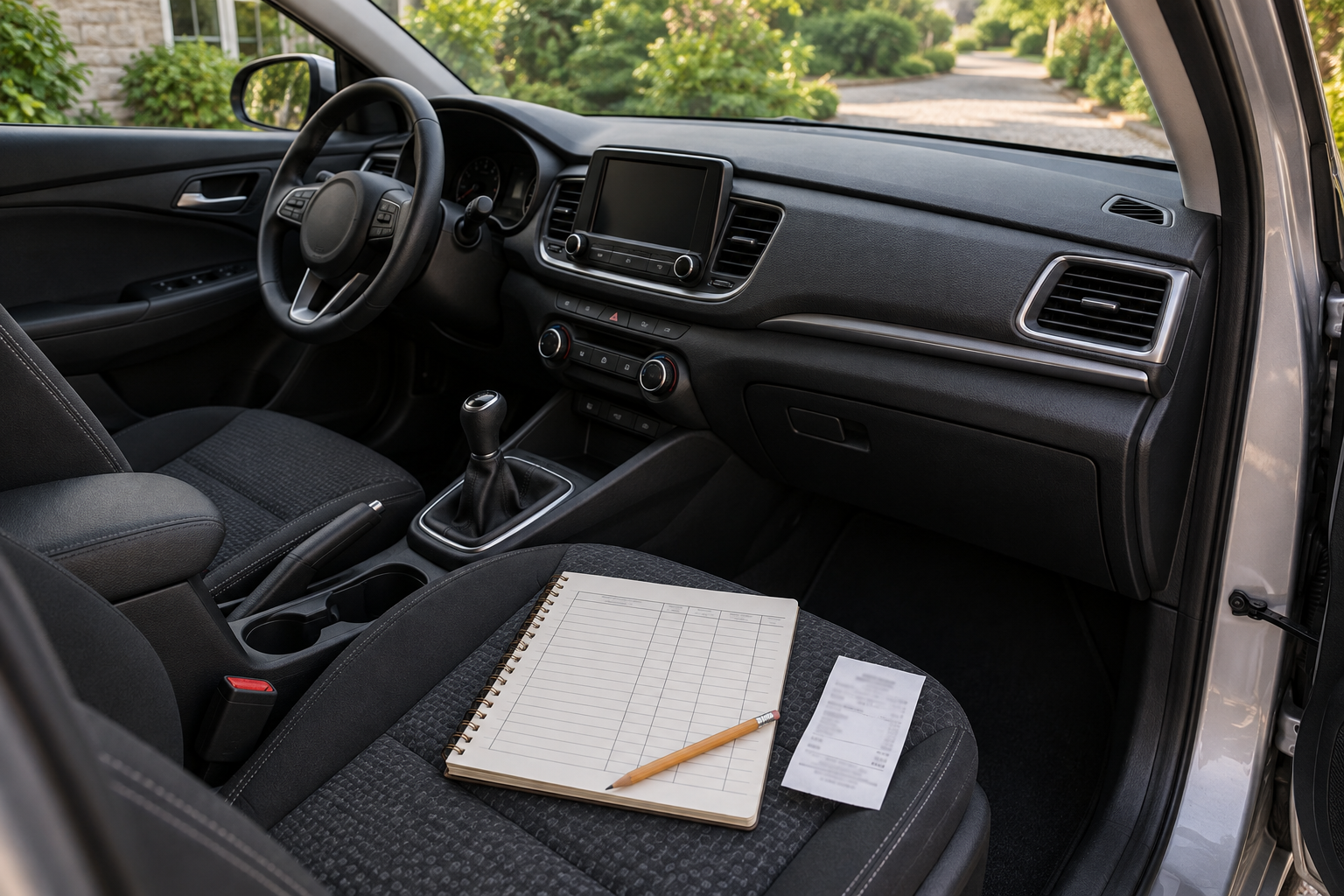
The linked official sources were read on 1 November 2026. Numbers and scenarios are original and hypothetical, not car-test results or current fuel prices. The generated image depicts recordkeeping inside a parked car and is not evidence of a measurement. This AI-assisted content has not received independent human editorial review.