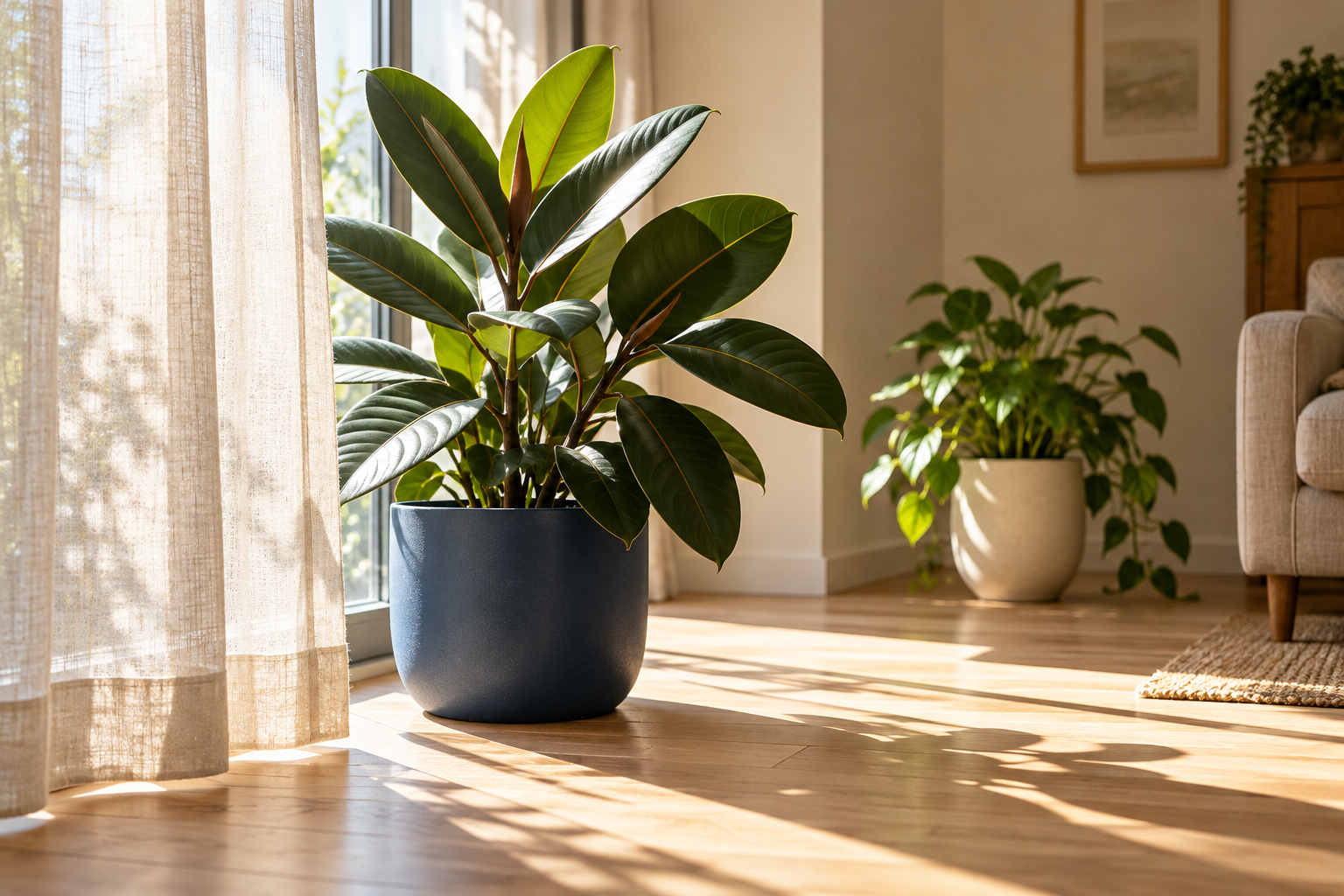
A room may look bright to you while a plant beside its window receives different light from one behind a curtain or on a distant shelf. Choosing a suitable position starts with describing light at the leaves and matching it to the plant's requirements. Calling the whole room “sunny” once is not a substitute for noticing how conditions change.
This is a method for organising observations and making a decision you can revisit, not a universal schedule of distances or hours. The generated illustration depicts a fictional arrangement of light and plants; it is not a growth trial or a recommendation to put a particular species there. The worksheet and examples are independent teaching material. This AI-assisted content has not received independent human editorial review.
Identify the plant before choosing its window
Start with the name on its label, including a scientific name if available, and look up its requirements through a reliable horticultural source. A common name may refer to different plants, and requirements for flowering may differ from simply maintaining foliage. If the identity is uncertain, retain a clear photograph and purchase label and seek identification rather than applying the first search result for a similar-looking plant.
The University of Minnesota indoor-lighting guidance links plant selection to the available light. Turn that principle into a small record: species, required light description, source and unresolved question. Do not write “low light” without keeping the reference's meaning. It does not authorise keeping a living plant in permanent darkness.
Map possible positions at leaf level
Choose two or three places you could actually use and label them A, B and C. Describe each with a fixed reference: beside the window edge, behind the curtain or on the inner shelf. You do not need an architectural drawing. You need to recognise the same position next week without guessing what “near the window” meant in your notes.
Record barriers between the sky and plant: a curtain, opposite building, canopy or tree. Include the curtain's position during observation. Comparing A with its curtain open against B with its curtain closed may compare two changing conditions as well as two places. Observe the leaves themselves: sunlight on the floor beside a pot does not establish that all its leaves receive that light.
- Position name and repeatable description.
- Observation date, time and general weather.
- Curtain position and visible obstructions.
- Whether direct sun reaches leaves during the check.
- What was observed and what remains unknown.
Separate direct sun from a general impression of brightness
Record a sunbeam reaching the leaves separately from your impression that the room looks bright. A position may have clear, diffuse daylight without direct sun during your check. A beautiful photograph's shadows do not establish that a plant received its daily requirement. A picture records a moment; the scene changes throughout the day.
When a reference specifies “bright indirect light”, keep that as a requirement needing interpretation for the species and setting, not a numerical reading obtained by eye. If you need a quantitative measurement, record the instrument, unit and method according to its instructions. Do not invent a number from the appearance of the room, or compare readings in different units as though they were interchangeable.
An example log with three observation times
Imagine a fictional room with three positions checked on one day at 09:00, 12:00 and 15:00. The table does not rank them from best to worst or recommend a plant for any of them. It demonstrates readable notes without turning an impression into a measurement that was never made.
| Position | 09:00 | 12:00 | 15:00 | Next question |
|---|---|---|---|---|
| A beside the window | Sun on some leaves | No direct sun during check | No direct sun during check | When did the sunbeam begin and end? |
| B behind the curtain | Curtain closed | Curtain closed | Curtain open | Does a consistent curtain position change the comparison? |
| C on the inner shelf | No direct sun during check | No direct sun during check | No direct sun during check | Is a measurement or reference needed to assess diffuse light? |
There are nine observations: three positions multiplied by three times. There are not nine hours of exposure. Nor can we say A received three hours of sun because 09:00 and 12:00 are three hours apart. Snapshot observations do not establish what happened between them. If we later track a whole interval from 08:15 to 09:45, it lasts 90 minutes. That still describes one position on one day, not a general prescription for plants.
Turn observations into one traceable decision
Compare the plant's requirement record with the position log. If the required light description is still unclear, the next action is clarifying that requirement or collecting more observations, not automatically buying equipment. If the reference calls for avoiding an exposure you observed in a position, investigate another position or an arrangement appropriate to that species.
Change one identifiable factor at a time and record what changed, when and why. It might be the pot's location, a curtain setting or a documented setting on a dedicated lamp. Do not change location, watering and feeding together and then attribute every result to lighting. This is a way to reduce confusion in your notes, not a promise that your home observations constitute a controlled scientific experiment.
Do not move a plant suddenly into the strongest available sun as a universal fix. Consult species-specific guidance when changing exposure. Choose a follow-up interval suitable for that plant rather than assuming one day or one week proves success for every species.
Use photographs as records, not light meters
Photograph the plant from a comparable position, including its location reference and curtain. Put the date in your log rather than relying on memory. Pictures can help you remember where the pot stood or compare visible growth, but they do not automatically measure the quantity of light the plant received.
A brighter second photograph does not establish that the light doubled: camera settings, angle and time may differ. If two pictures were taken under different conditions, record that fact. The useful picture in an observation log is not necessarily the prettiest one. It is the one whose circumstances and comparison limits you understand.
Revisit the map when conditions change
A window's compass direction is useful information, but it does not summarise nearby buildings, obstructions, season and geographical setting. Do not transfer a recommendation written for another country directly to your home without checking what actually happens. The references linked here primarily address United States and United Kingdom contexts. Use their emphasis on identifying plants and conditions rather than treating their window descriptions as worldwide rules.
The Royal Horticultural Society houseplant guide connects positioning to plant requirements. Repeat observations after replacing a curtain, moving a shelf or noticing a seasonal exposure change. You do not have to erase the old log. Keep it with the change date so you can understand why two days did not provide equivalent comparisons.
When should you investigate supplemental lighting?
Begin with a specific question: which requirement cannot be met in your available positions? A “plant light” label alone does not define coverage, distance or operating duration for your plant. Before buying, bring together its needs and the product's installation and use instructions, then check whether those instructions can actually be followed in the proposed location.
List what is known and unknown: stated coverage, permitted mounting position, timer adjustment and avoiding water contact as the instructions require. This guide recommends no particular product, wattage or universal operating schedule, and it does not explain wiring modifications. If suitability for the intended use remains uncertain, get clarification from the appropriate supplier or specialist before operating the equipment.
Do not diagnose a plant from one symptom
A leaf changing colour or slower growth does not alone prove inadequate light. Keep a specific description: when did the change appear, did it affect new or old leaves, and what changed in location or care? That information makes a question to a horticultural adviser more useful than “my plant dislikes the light”.
If a problem is worsening quickly or its cause is unclear, repeatedly moving the plant every day is not a substitute for understanding it. Document the condition and seek an appropriate assessment, especially when you do not know the species or care history. This guide organises information; it does not diagnose a plant from a photograph or a generic timetable.
A short action list and reusable record
- Establish the plant's identity and requirements reference as far as possible.
- Name realistic positions with descriptions you can repeat.
- Record light at the leaves at several times, including weather and curtain position.
- Separate a momentary observation, exposure duration and quantitative measurement.
- Identify one missing fact or one justified change.
- Document the change and photographs, and select a suitable follow-up interval.
- Reassess when conditions change and seek help if the cause remains unknown.
A log entry can contain: date, species, position, conditions, observation, change, reference and next question. Do not add a “success” box before defining what would count as improvement and how you will assess it. The aim is to make an understandable decision and know why you made it, rather than accumulate photographs with no useful context.
Sources and application limits
The University of Minnesota and Royal Horticultural Society references linked above were consulted on 1 November 2026. The table, nine-observation calculation, 90-minute example and decision record were created for this article, not taken from a horticultural trial. There are no measured light values or guaranteed-success species lists here. Details must be checked against the plant, climate and actual equipment.