You can book an experience described as responsible and still find no clear answer about photography, group size or how the place is treated. You may also arrive with good intentions but little understanding of what your hosts or the site managers expect. Responsible travel becomes practical when intentions turn into decisions you can carry out and examine.
This guide does not certify a business or destination, calculate your trip's environmental impact or explain a country's entry requirements. It offers a decision card for before, during and after a visit, alongside a fictional example. The aim is to understand what you have agreed to, respect people and places, and describe your experience honestly without claiming that your choices have no impact.
Start with the actual place's instructions
Tokyo's official visitor guide connects responsible visits with culture, environment and consideration. Do not automatically transfer one destination's details to another. Find guidance from your host or the management of the site you will visit, identifying what concerns access routes, photography, booking and group visits.
Save the guidance link and the date you read it, then check for changes before setting out. If an old advertisement conflicts with a newer notice from management, ask which arrangements currently apply instead of choosing the easier answer. A photograph of other people doing something does not establish that it is permitted or appropriate for you at every time.
Write down what you do not know before booking
Identify questions that affect your decision. Is the activity set up to welcome visitors? Who runs it? Which spaces can you enter? Does the itinerary allow time to understand an explanation rather than simply passing through for photographs? You need information that helps you accept, adjust or decline an experience, rather than a long collection of appealing slogans.
Where an answer is unavailable, write “unconfirmed” instead of assuming the best. Send the operator one clear question and keep the reply with your trip notes. For example: “Does the visit include a private space, and what arrangement has been agreed with its owners?” This is more useful than requesting a general promise of sustainability without defining what the term means in this setting.
A compact visit decision card
| Decision | Practical question | What to record |
|---|---|---|
| Place | Who sets the current visiting instructions? | The relevant link or management's guidance |
| Experience | Who hosts it and what does it include? | A clear description and participation boundaries |
| Photography | Are taking and sharing photographs appropriate in this situation? | The agreed choice, without unnecessary images |
| Purchases | What do I know about the item and its maker? | What the seller confirmed and what remains unknown |
| Waste | How will I handle what I carry under this place's instructions? | A workable plan without assuming bins are always available |
| Alternative | What will I do if the activity becomes unavailable? | A permitted option that does not pressure the host |
One page may be sufficient. Do not collect staff members' personal details or photographs of documents to prove that you checked. Record what you need for your decision and leave uncertainties visible. This is a personal planning aid, not a rating system or a certificate you award to the people who run the place.
A fictional example: a small workshop and a crowded visit
Imagine a group planning to visit a craft workshop. The programme says that work continues during visits, but gives no group size or photography arrangements. Before booking, the group asks about suitable numbers, available space and how to request permission. In this fictional case, visitors standing around the workbench would block the craftsperson's movement, so the host proposes a different time or splitting the group.
The visitors accept an adjustment instead of insisting on the scene they had imagined. During the visit, one person wants to photograph an object and then share an image that includes the worker. Permission to photograph the object does not settle whether the person agrees to appear in a shared image. The visitor asks again and accepts a refusal without argument. This is an educational scenario, not an invented account attributed to a real workshop owner.
Afterwards, the group explains that the visit size changed at the host's request and photography was limited. They do not claim to have saved a craft or delivered a particular economic benefit they did not measure. A modest description of what happened is more accurate than turning an enjoyable day into an unsupported impact story.
Photography requires an understanding of context
Ask in a way the person can understand. Do not treat a smile for a camera as unrestricted agreement to every later use. Where sharing is your purpose and people or a private activity are involved, explain that purpose before taking the photograph. Follow the site's instructions and avoid blocking an entrance or working route to obtain a better angle.
Do not turn people's ordinary moments or needs into a promotional backdrop for your trip. You can enjoy a scene without recording it, or photograph permitted details that do not reveal people. When sharing material, remove private location information or details its subjects may not want public. Do not attribute words or stories to someone who never supplied them.
Local purchases call for questions, not assumptions
When considering a craft item, ask about its materials, production and maker to the extent relevant to your choice. “Local” might describe the shop, the design or the manufacturing location, which are different things. Record what you confirmed instead of applying a broad description to everything bought at a market.
This guide does not assume every small producer is automatically better or that a higher price establishes ethical quality. Choose something you need and whose origin you can understand, without demanding private information from the seller as proof. If a material's origin or whether you can transport it is unclear, consult the appropriate authority before buying instead of relying on verbal reassurance. This article does not supply general customs rules.
Outdoors, ask what conduct the site requires
Leave No Trace offers principles for reducing outdoor impacts. Use that resource as an introduction, then follow guidance specific to your destination. This article does not reproduce the organisation's list or turn it into blanket permission for an activity anywhere.
Before joining a tour, ask how the organiser chooses routes and stops, and what happens if visiting conditions change. Do not ask a guide to approach an animal or enter a prohibited route for a photograph. Where arrangements are unclear, stop and ask site staff instead of treating footprints or earlier visitors' photographs as sufficient evidence.
Plan what you will carry in and bring back, using available disposal facilities as directed. Do not assume something apparently natural can be left wherever you choose. Nor should you independently “improve” a place by moving objects, removing plants or rearranging them. Good intentions do not establish that you understand the role of what you see.
Examine environmental claims before repeating them
If an activity calls itself “impact-free” or “certified,” ask what the description means, what it covers and which organisation can verify it. A claim may relate to one operational element rather than the entire experience. Do not treat an advertising symbol as comprehensive evidence or give figures for emissions or water your visit saved without a documented method and suitable information.
You can say you selected an activity that publishes a particular policy, linking to it and explaining the limits of your checks. That is more precise than declaring all its practices responsible. Inability to verify something can remain part of your decision; you do not have to award a positive certificate or make a negative accusation to explain your choice.
Leave room to change your plan
A suitable alternative reduces the pressure to insist on an unavailable activity. Agree with your companions that a closure or a host's request to change timing is not an invitation to bypass restrictions. Check the booking and cancellation terms of your particular service rather than assuming all operators use the same policy.
During busy periods, consider where you can wait without blocking entrances or services residents use. If the programme moves faster than you can follow, choose a smaller portion instead of asking everyone to accelerate. Unscheduled time may allow a calmer visit, but that is not presented here as a measured environmental outcome.
Write a useful account afterwards
Separate what you directly observed, what the operator told you and what you inferred. Give the date and limitations of your experience, avoiding claims about an entire community or country based on one visit. A specific observation about clear instructions or a photography request is more useful than “the best and most sustainable” without supporting evidence.
Make feedback actionable: identify an unclear instruction or an unanswered question. Protect people's information in photographs and attachments. Update your next trip plan with what you learned without turning travel into a collection of moral certificates. The practical aims are considered decisions, tangible respect and an honest account.
Sources and image
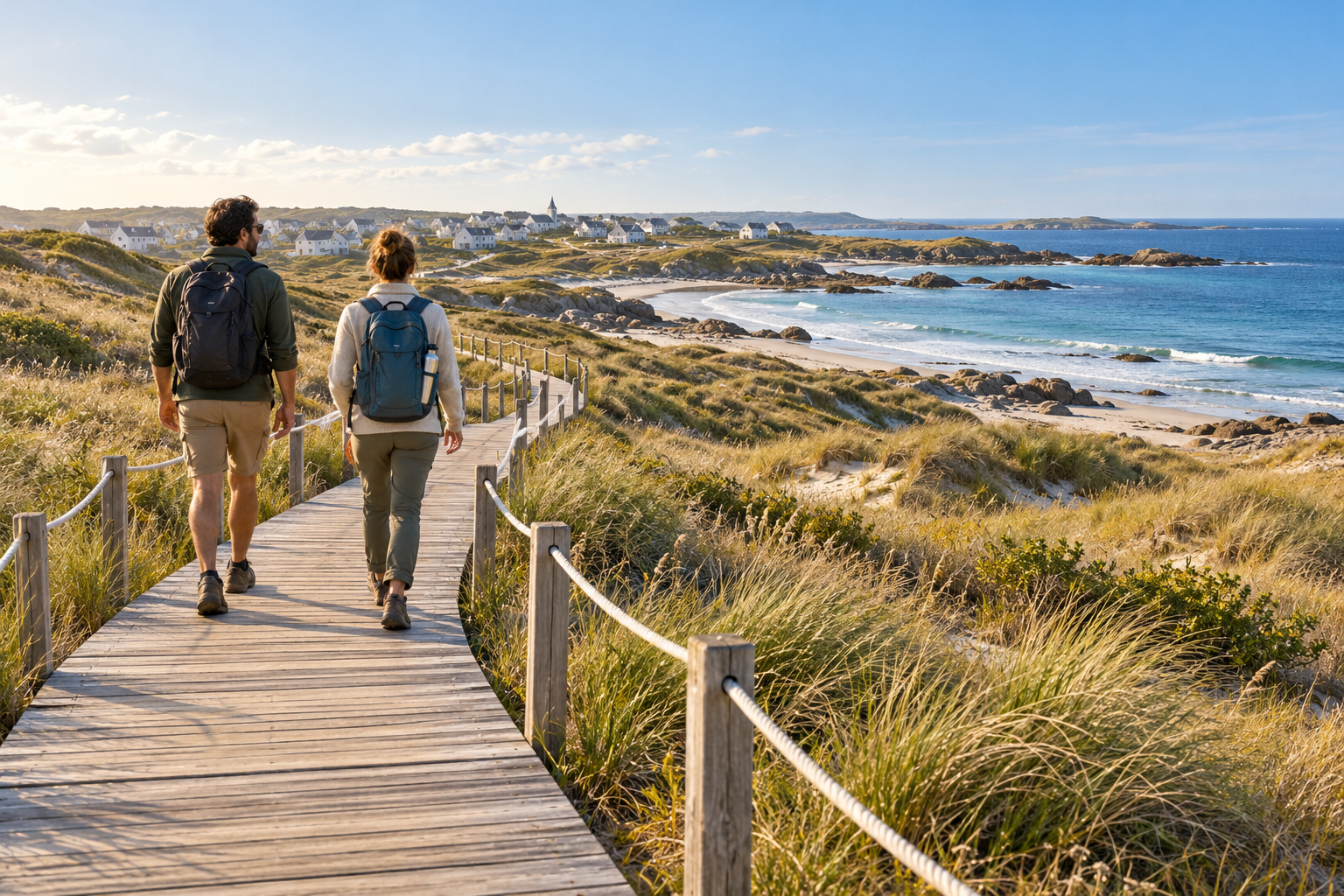
The two linked sources were consulted on 1 November 2026. The decision card and workshop scenario are original editorial examples, not an impact study or field experience. The generated image shows visitors on a coastal boardwalk in an imaginary place and certifies no real destination. This content was prepared with AI assistance and has not received independent human editorial review.