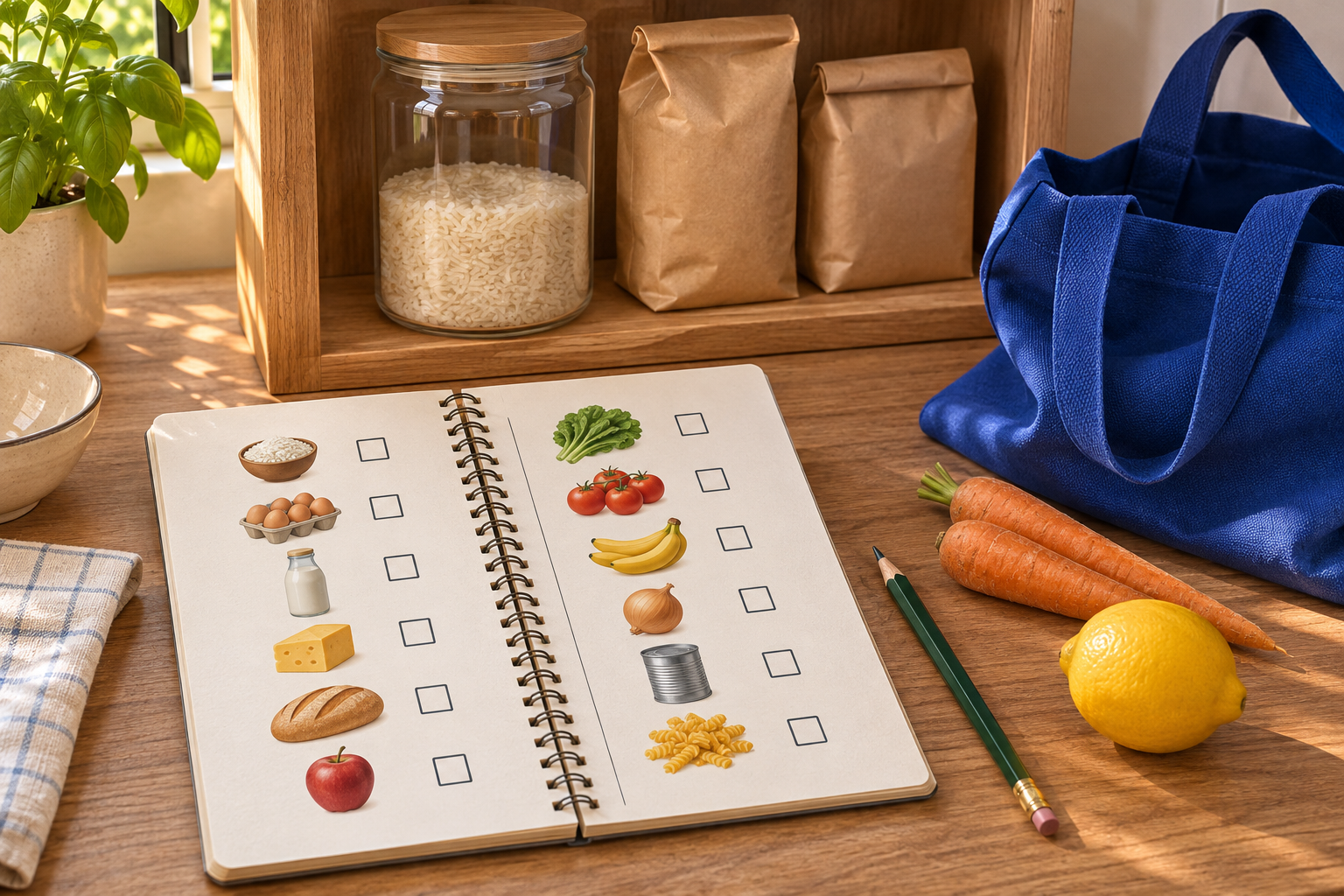
A useful shopping list does more than collect the names of things that crossed your mind. It distinguishes what you need, what you already have, what somebody else bought and what remains pending because it was unavailable. Without those distinctions, you can take a long list and return with duplicate purchases while the original need remains unmet.
This guide organises quantities and changes within a shopping list. The calculations and requests are fictional, not recommended food portions or shop prices. The generated image depicts imaginary household planning, not a receipt or an app test. This content was prepared with AI assistance and has not received independent human editorial review.
Separate reminders from the list for this trip
You can immediately add “paper has run out” or “we need rice” to an initial collection list. Before leaving, turn those notes into a trip list with a date or purpose. Some requests may be urgent, others for next week, and others already present under a different name. Do not turn every thought into an automatic purchase instruction.
Choose a planning period that matches what you actually know about your use. When household plans change, update the request before shopping instead of defending an old plan. No single list length or number of trips suits every household. What matters is that the buyer knows which requests belong to this trip.
Check what is available before calculating the shortage
The EPA's food-waste prevention guidance mentions checking stock and planning quantities. In our practical list, knowing that a package exists is not enough. Record whether it is full or open, and distinguish the amount available for this task from quantities reserved for another use.
If you cannot determine the remainder accurately, write “needs checking” instead of turning a guess into a confirmed quantity. You do not need to weigh every item on every trip. However, when a small quantity determines whether another package is needed, checking is clearer than unreliable memory. This does not establish food safety; follow the relevant product and storage instructions separately.
Write a line another person can act on
A useful line contains a specific name, quantity, unit and status. “Rice” leaves many questions; “dry rice, need to buy 450 g for the plan, check available package size” communicates a clearer decision. Do not confuse contents weight with package count or assume that every package of the same item has the same size.
Add only necessary constraints, such as a particular paper size or a product type compatible with the intended use. If a brand is merely preferred, distinguish that from a requirement that cannot be substituted. For food, do not assume an alternative meets somebody's personal restrictions. Leave that decision to the person and product information rather than guessing.
A worked example of the required quantities
The following table is an independent organisational example. “Available” means checked and available for this plan, not everything that might exist at home. Calculate only the shortage. When stock exceeds the requirement, the purchase quantity is zero, not a negative request.
| Fictional item | Planned requirement | Available for this plan | Shortage |
|---|---|---|---|
| Dry rice | 900 g | 450 g | 450 g |
| Notebooks | 5 notebooks | 2 notebooks | 3 notebooks |
| Printing paper | 120 sheets | 200 sheets | 0 sheets |
Rice uses 900 − 450 = 450 g; notebooks use 5 − 2 = 3. The paper stock covers the requirement and leaves 80 sheets. That remainder is not a reason to add another request. These numbers explain a method; they do not prescribe suitable quantities for every household.
If you need 450 g of rice but only a 500 g bag is available, the purchase supplies 50 g beyond the shortage. Record that difference for the later stock update. Do not rewrite the original requirement merely to make it match the package. Accepting the package or postponing the request depends on use and space, but the decision should remain visible.
Keep the request's status instead of deleting it too soon
Use simple states such as “needs checking”, “to buy”, “bought by this person” and “deferred”. Moving a request to “bought” differs from deleting it: retaining a record tells others it was completed rather than accidentally lost. Completed entries can be hidden from the trip view while remaining available for review.
For a partial purchase, record the actual amount and what remains. In a fictional request for three notebooks, buying two leaves one outstanding. A general completed tick on the entire line hides that shortage. If the need changes during the trip, update it with a reason instead of leaving contradictory quantities.
Agree on what shared-list marks mean
One person may use a tick to mean “checked the cupboard”, while another means “bought the item”. Agree on one meaning before sharing. You can assign someone to a group of requests or write “I will handle this” before buying, then record what actually happened. A temporary reservation is not confirmation of purchase.
Do not assume an app synchronises every edit instantly under all conditions. With weak connectivity or two different copies, agree on the latest authoritative version and how to update it. A shared list does not need sensitive personal details merely because an application offers a notes field.
Arrange the list to support the trip
The New South Wales Love Food Hate Waste shopping guide discusses list organisation and quantities. Use groups appropriate to your trip, such as stationery and pantry items, rather than jumping between scattered lines for the same product.
Combine matching requests after aligning units and checking their purposes. Two rice requests of 300 g and 150 g total 450 g if the same suitable type is required. Do not combine them if one purpose needs a different product. Visual tidiness should not erase an important constraint.
Treat substitutes and offers as new decisions
When an item is unavailable, do not replace it solely because something has a similar shape or size. Review the required function, quantity and written constraint, then choose an acceptable alternative or defer the request. “Unavailable” is more useful than recording the purchase of something that does not meet the basic need.
A two-pack promotion does not mean the list needs two packs. Before changing the quantity, consider planned use, space and total outlay. This does not reject every offer; it prevents an advertisement from automatically becoming an order. Record the revised quantity and surplus instead of keeping an old list that no longer describes the purchases.
Review the list when you return
Match actual purchases with requests: what arrived, what was deferred, what was substituted and which package size changed. Update stock with the quantity you bought, not the amount you intended to buy. In the rice example, adding 500 g to the existing 450 g gives 950 g before planned use. Using 900 g then leaves 50 g in this arithmetic example.
Keep useful notes for the next trip, such as an ambiguous name or different package size. Do not turn every difficulty into a permanent quantity increase. The problem may be the description or list sharing, not a need to hold more stock.
A quick quality check for your list
- Does this request belong to the current trip or a later idea?
- Have you checked stock available for this need?
- Are quantity and unit clear to another person?
- Have you separated essential conditions from preferences?
- Do you know who handles the request and what its status means?
- Are partial purchases and substitutes recorded?
- Will you update stock using actual quantities after returning?
If a point is unanswered, turn it into a checking task instead of adding random spare items. A list is not judged by its length. It succeeds by communicating the need clearly and preserving changes during the trip, without guaranteeing a particular saving or complete elimination of waste.
Sources and limits
The two linked references were read on 2 November 2026. They provide shopping-organisation context only; statistics, prices, examples and food-storage instructions were not reproduced. The table, request states and calculations were created for this article. This is not a diet plan or a judgement of product safety. It is a way to manage a shopping list that can be understood and updated.