You can remember everything that happened in a film and still struggle to explain why a scene affected you. A plot summary answers what happened. Narrative analysis asks how the work arranged events, distributed information and presented decisions, and what evidence supports your interpretation. You do not need a paragraph crowded with theoretical labels. You need a specific observation, a defensible explanation and a clear boundary around what you do not know.
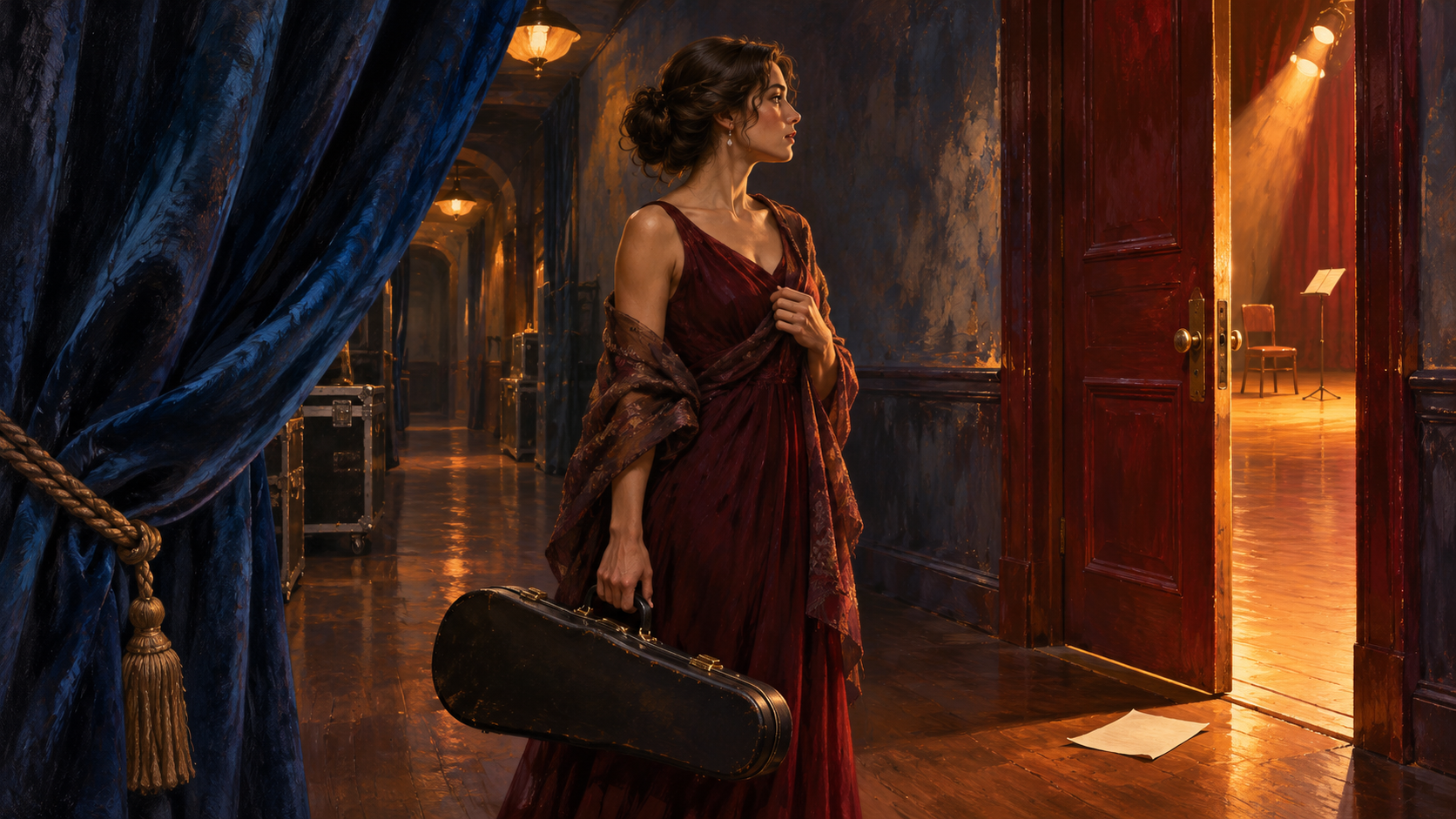
This practical guide is for viewers who want to write a short reading or discuss a scene with others. It uses an original fictional situation involving a violinist waiting for an audition, rather than a sequence taken from an existing film. The accompanying generated illustration depicts that invented situation; it is not a film still or evidence of a real audition. The examples demonstrate a method without suggesting that a work of art has only one legitimate interpretation.
Start with a question smaller than the whole film
“I will analyse the film” is so broad that every detail can seem relevant. Choose a question you can follow through evidence: how does this scene make us hesitate before judging a character's decision? Or how does a late revelation change our understanding of an earlier action? Identify the version and sequence you are discussing. If precise references matter, record timestamps from the version you watched rather than assuming another platform's timings match.
Give readers a suitable spoiler notice when your argument reveals the ending. You can describe the general viewing experience first and separate the section that discusses events in detail. What matters is consistency: do not promise a spoiler-free review and then rely on the final surprise without warning. The scope of your piece should be clear before the reader reaches information they wished to avoid.
Establish the example before interpreting it
In our invented scene, Leila arrives in a theatre corridor carrying her violin case. She wants to enter an audition on time. She hears her name called from the room, then notices a sheet of music that has fallen from the bag of another musician waiting farther down the corridor. The viewer can see the sheet, but the other musician has not noticed it. Leila stops, picks it up and returns it before entering. The sequence ends at the door; we do not see the audition result.
These are the facts constructed for this example, not a synopsis of an existing film. Leila's immediate desire is clear. The obstacle is limited time and competing priorities, not necessarily an evil opponent. Her choice allows a discussion of concern for another person. It does not establish that she will succeed at the audition or behave similarly in every situation. Keep the conclusion proportionate to the evidence available.
Separate an action from a permanent trait
“She returned the sheet” describes a particular action. “She is always generous” makes a broader claim than this scene supports. A more precise formulation is that the action presents her here as willing to risk a brief delay to help someone else. A later scene might support or complicate that reading. Good analysis leaves room to revise a first impression rather than turning it into an irreversible verdict.
Distinguish event order from presentation order
The events could occur in the order described above while the film presents them differently. Imagine a version opening with Leila's hand returning the sheet, then moving back to the moment when her name was called. Imagine another version initially concealing the sheet: we see her stop without knowing why, and only later see what caught her attention. The underlying actions are similar, but viewers receive information at different moments.
That difference changes the question we carry through the scene. We might initially wonder why she is late, or revise a hasty assumption that she is afraid to enter. Merely naming a transition a flashback is insufficient. Explain which information was delayed and what belief that delay allowed us to form. If the timing is ambiguous, identify the cues favouring your interpretation rather than asserting an unproven chronology.
Track who knows what at each moment
We might know about the fallen sheet before Leila notices it, making the wait for her discovery part of the experience. We might learn alongside her and wait for her decision. Alternatively, we might see her face without seeing the object of her attention, leaving us with less information than she has. These are different arrangements, not interchangeable labels for mystery or suspense.
For each important moment, note what the audience knows, what the character appears to know and what remains uncertain. Do not attribute information to a character unless the work provides grounds for it. Equally, an event not being shown does not conclusively prove it never happened. “We have not been shown this” and “the work establishes that this did not happen” are different statements, especially in narratives that deliberately leave gaps.
Treat image and sound as evidence
Film events do not reach us independently of their presentation. A wide shot could establish the distance between Leila, the door and the other musician. A closer view could draw attention to her hesitant hand. The call of her name could remain offscreen, sustaining time pressure without showing the caller. These are possible formal choices for our invented sequence, not claims that the generated cover image contains a complete moving film.
A colour does not have one fixed meaning in every work. Warm light at the doorway might help the audition room appear inviting, but it might also follow the ordinary lighting of the location. Strengthen your interpretation by asking whether the choice recurs in related moments and how it interacts with movement, performance and sound. When your evidence consists of one shot, make a suitably limited claim about that shot.
Ask what the observation adds
“There is quiet music” is a starting description. Ask when it begins or stops, whether footsteps remain audible and how a transition changes your expectation. Your response does not give you automatic access to the filmmaker's intention. You can explain how a choice supports an effect in your reading without inventing a statement from a director whose words you have not consulted.
Separate observation, interpretation and limits
The following table is an exercise built around our fictional example, not a marking scheme for scoring every film. Its purpose is to expose the step between seeing something and drawing a conclusion, including plausible alternatives where the evidence permits them.
| Invented evidence | Possible interpretation | Limit or alternative |
|---|---|---|
| The name is called before the sheet is collected | The decision occurs under immediate time pressure | The actual penalty for delay is unknown |
| A wide shot includes the door and musician | The two demands are made spatially clear | The framing alone does not establish a moral judgment |
| The sheet is returned before Leila enters | Helping receives priority at this moment | This does not establish her behaviour in every situation |
| The sequence ends at the door | The decision matters more than the audition result here | The wider work could reveal that result later |
Build a paragraph around an argument
Instead of recounting the actions again, start with a specific proposition: “The scene makes the decision to help the centre of its tension, rather than the audition result.” Then identify the call, the sheet and the pause, explaining how their arrangement brings two competing demands together. Finish with a limit: the ending does not reveal Leila's success, so helping cannot be described as a proven cause of a later reward.
The paragraph needs a connection between evidence and conclusion, not a pile of terminology. If removing a sentence leaves the argument intact, that sentence may repeat rather than develop the idea. If another film's title could replace yours without changing the paragraph, add an observation that actually belongs to this sequence. No word count guarantees good criticism; a focused passage can offer more than pages of unexplained plot summary.
Avoid templates that erase the work's particular form
Some stories have no single central character, direct goal or ending that settles every question. Repetition, waiting or multiple perspectives may be part of their organisation. Use questions as tools for noticing, rather than forcing every work through fixed stages and treating their absence as a defect. Also distinguish identifying a choice from evaluating it: an open ending is a description, while calling it convincing requires an argument.
For documentaries, analysing tension and character does not establish whether factual claims are true. Those claims need separate examination of sources and context, with observation distinguished from opinion. Compelling presentation is not historical proof. This guide concerns narrative form; it does not certify the accuracy of everything that appears onscreen or replace subject-specific research where a film makes factual assertions.
Review your reading before sharing it
- Identify the work, version and scene, and flag spoilers where necessary.
- Choose a question that evidence from the sequence can answer.
- Separate observable events from interpretation and unestablished authorial intention.
- Consider information order, image and sound without relying on rigid symbol dictionaries.
- Include an alternative reading or a limit when the evidence is open to more than one explanation.
- Use your own description and check rights before reproducing a still or clip.
Try the method on a short scene you can legally revisit. Watch once for the general experience, then return to the moments your argument needs. Record what changed in your interpretation rather than simply counting the details you collected. The aim is a clearer reading that others can discuss, not a claim to have uncovered a secret meaning beyond disagreement.
Sources and scope
Educational resources were used for brief general principles: Moving Image Education: Reading Film connects narrative with audiovisual elements, while Screening Shorts: Reading a Film Narrative provides context on desires, obstacles and the development of a narrative. Both were consulted on 4 November 2026. Leila's story, the table and the practical prose are independently constructed; no source exercises, film images or published dialogue have been reproduced.