You can use the same named ingredients and still produce a different dough each time because “a cup” does not, by itself, reveal the weight of flour that reached the bowl. Conversely, owning a scale does not prevent mistakes if you read the wrong unit or add an ingredient twice. Useful baking measurement combines understanding the recipe, a suitable tool and a clear record of what has actually been added.
This guide explains organising quantities, conversions and changes in batch size through independent arithmetic examples. It is not a complete recipe for a baked product or guidance on preservation or shelf life. The teaching figures should not be used alone to make a mixture: they do not include preparation, baking conditions or food-safety requirements.
Read the ingredients and method before measuring
Read the entire recipe and identify ingredients divided between stages. An overall quantity may be listed, with part intended for the dough and part for a later step. Mark that detail before emptying everything into one bowl. Also read each ingredient's description: type, condition, unit and any instructions about how to measure it.
Separate quantities from equipment and time. Changing a pan's size or the shape of individual pieces is not simply an edit to the ingredient list. For a first attempt, preserve the original recipe and record any deliberate change so it does not become confused with the original instructions when reviewing the result.
The King Arthur Baking recipe success guide recommends weighing when a scale is available and following the specified ingredients, method and pan size. It also describes its approach to volume measurement. A developer's method does not establish that every source uses identical conversions.
Do not confuse mass and volume
Grams measure mass; millilitres measure volume. Replacing one unit name with another in a table does not perform a valid conversion. Keep the stated unit beside every ingredient. When a conversion is needed, seek guidance specific to that ingredient and recipe rather than applying one number to flour, sugar and liquids alike.
Two equally sized cups can contain different masses of different ingredients. Filling a measure differently can also change how much it contains. The America's Test Kitchen flour conversion explanation relates cup weight to the developer's filling method. A conversion selected randomly from search results might not match the original recipe.
Prepare the scale and bowl clearly
Place the scale on a suitable surface according to its instructions and check its displayed unit, capacity and display resolution. Add the bowl, then use the zero or tare function as the device specifies. The aim is to read the intended ingredient's quantity rather than accidentally including the bowl's mass.
Check that you can read the display before combining several ingredients. If the bowl hides the digits, arrange the tools securely before adding anything. Do not wait until the bowl is full to discover that you do not know which unit is shown. The bowl and all its contents must remain within the scale's permitted load.
For very small quantities, examine whether the tool can meaningfully measure the amount required. A display showing whole numbers does not mean every small amount can be measured adequately. If the recipe specifies a standard measuring spoon for a small ingredient, do not replace it with a guessed gram conversion below your scale's useful resolution.
Choose sequential weighing or separate measurement
Weighing ingredients successively into one bowl can reduce equipment, but requires careful tracking of additions and resets. Measuring some ingredients into separate bowls can make an error easier to identify before mixing. Choose according to the recipe and your ability to keep track, not a blanket rule that fewer bowls are always better.
For example, a powdered ingredient that would be difficult to remove after an overshoot can be measured separately and transferred at the appropriate step. Keep measured bowls on one side and move used bowls to another. This reduces reliance on memory when deciding whether sugar or salt has already been added.
| Situation | What to record | Avoidable error |
|---|---|---|
| Weighed ingredient | Required quantity and unit | Counting the bowl as ingredient |
| Divided ingredient | Amount for each stage | Adding the total too early |
| Small quantity | Appropriate measuring tool | Rounding the tool cannot support |
| Ingredient already added | Clear check mark on the sheet | Adding it again after an interruption |
An arithmetic example for changing the number of pieces
Imagine a teaching list for twelve pieces containing 300 grams of flour, 180 grams of sugar and 120 grams of butter. We want to calculate quantities for eighteen pieces of the same assumed size. The factor is 18 ÷ 12 = 1.5. Multiplying each amount gives 450 grams of flour, 270 grams of sugar and 180 grams of butter.
This is not an executable recipe: other ingredients and the method are missing. It illustrates that the factor applies to the relevant full list, not just the flour. If some of an ingredient belongs to a separate stage, retain that division after changing the total.
Changing the same list from twelve pieces to six instead uses a factor of 0.5, producing 150, 90 and 60 grams. Write the entire revised list before starting. Recalculating mentally at each addition increases the chance of omitting an ingredient or switching factors midway through.
Why simply multiplying baking time is insufficient
Doubling ingredient quantities does not, in this worksheet, automatically double the time. Quantity arithmetic contains no information about pan shape, mixture depth or batch arrangement. Consult the recipe's guidance on size or yield changes. If none is provided, seek a suitable version rather than presenting a guess as established instructions.
When several batches are needed, record what belongs in each and when it will be prepared. This guide does not establish a safe time for leaving dough or ingredients unrefrigerated. Recipe and ingredient-handling instructions remain necessary; correct multiplication and division cannot replace them.
Handle a quantity that is difficult to divide
Scaling down can produce part of a unit originally listed by count, such as part of an egg or package. Do not assume rounding upward leaves the recipe unchanged. Look for the developer's guidance on reducing the recipe, or choose a suitable whole quantity. When the source provides a weight or division method, follow it with the relevant safe-handling instructions.
Record the original package size too if the recipe says “one package” without a clear weight. Packages can differ between markets. Turn the ambiguity into a question for the source before shopping instead of choosing the closest-looking package. Otherwise, a mismatch in the intended product can look like a fault in the recipe.
Make the conversion reviewable
Use columns for original quantity, factor and result, and preserve the source link and version date. If an electronic tool performs the calculation, check one ingredient by hand and ensure the units have not changed. Do not copy a result without knowing whether it represents a whole batch or one portion.
In the example, the three original ingredients total 600 grams; after multiplication by 1.5, the total is 900 grams. This is a useful arithmetic cross-check, not proof of a valid recipe or good result. If an ingredient was omitted from the entire table, its internal calculations could look consistent while the list remains incomplete.
Record an attempt without inventing its explanation
Afterward, record what you actually did: recipe, changed ingredient type, measuring method, pan size and any documented alteration. Describe the observed result before jumping to an uncertain cause. “Used a conversion from another source” is a traceable fact; “the flour was bad” is an interpretation requiring different evidence.
For a later attempt, make changes you can track instead of altering many things and losing the reason for improvement. This does not mean repeating an unsafe procedure: safety and product instructions come first. The guide organises measurement and does not assess whether food is safe or properly cooked.
A final checklist before mixing
- I read the whole recipe and identified ingredients divided between stages.
- Units are clear and conversions come from an appropriate source.
- The scale and measures can handle the required amounts within their limits.
- I wrote the revised quantities beforehand and checked the factor.
- I distinguish ingredients already used from those awaiting addition.
- I did not infer cooking time, shelf life or a food substitution from arithmetic alone.
If another task interrupts measurement
Before stepping away, note the last completed addition and what remains. If you return uncertain whether a small ingredient was added, do not infer that from the mixture's appearance or taste raw ingredients to check. Review the bowls and marks. If the information remains unknown, treat it as unresolved rather than adding another amount at random.
Equipment arrangement can reduce these situations: keep the recipe visible away from splashes, with separate places for prepared ingredients and used bowls. This is a workflow, not a guarantee of success, but it makes resuming after an interruption less dependent on memory.
Sources and transparency
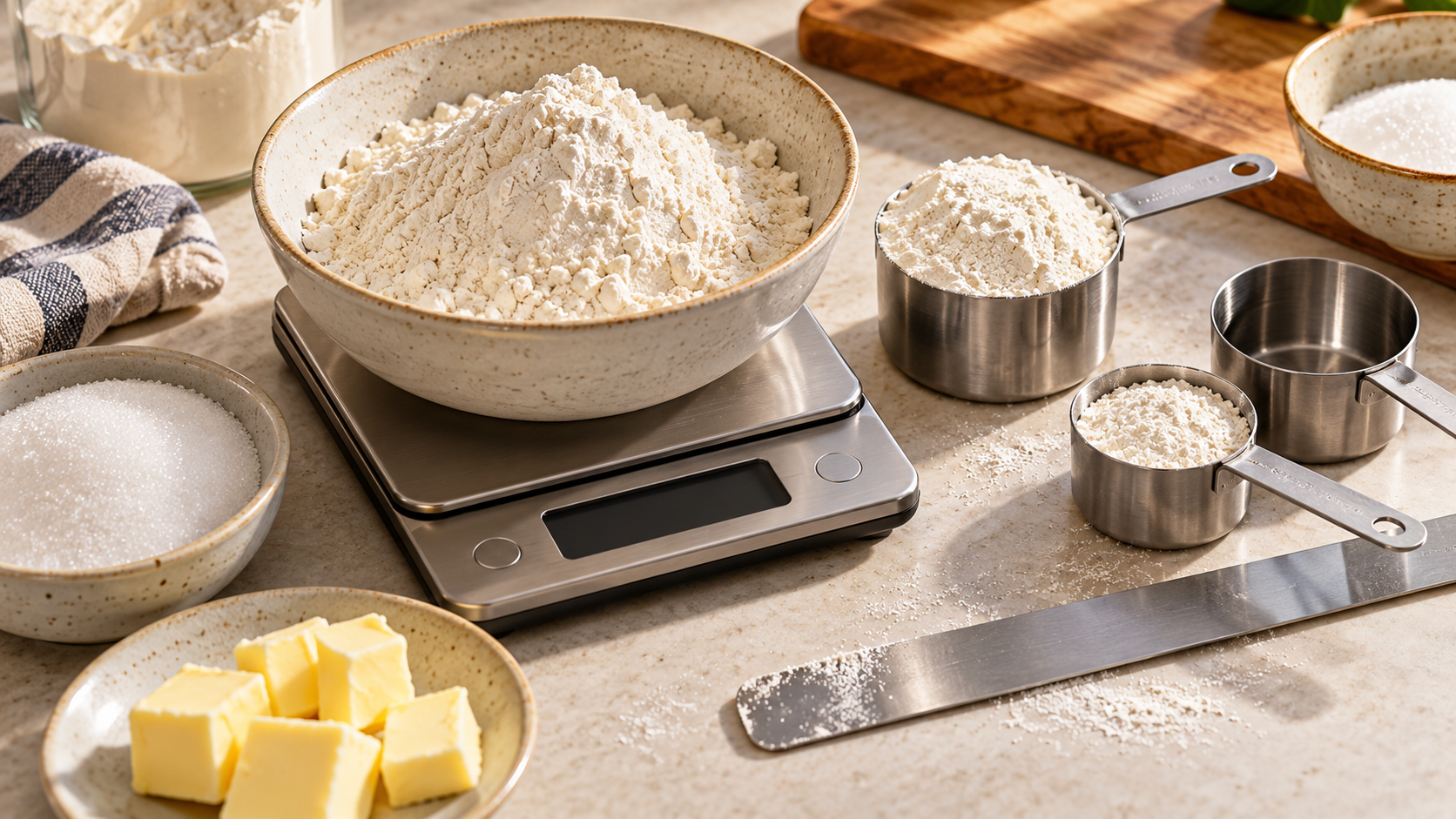
The linked sources were read on 1 November 2026. Tables and calculations are original teaching material, not a tested recipe. The generated image illustrates measuring equipment and ingredients; its filled cups are not instructions for a final amount. This content was prepared with AI assistance and has not received independent human editorial review.