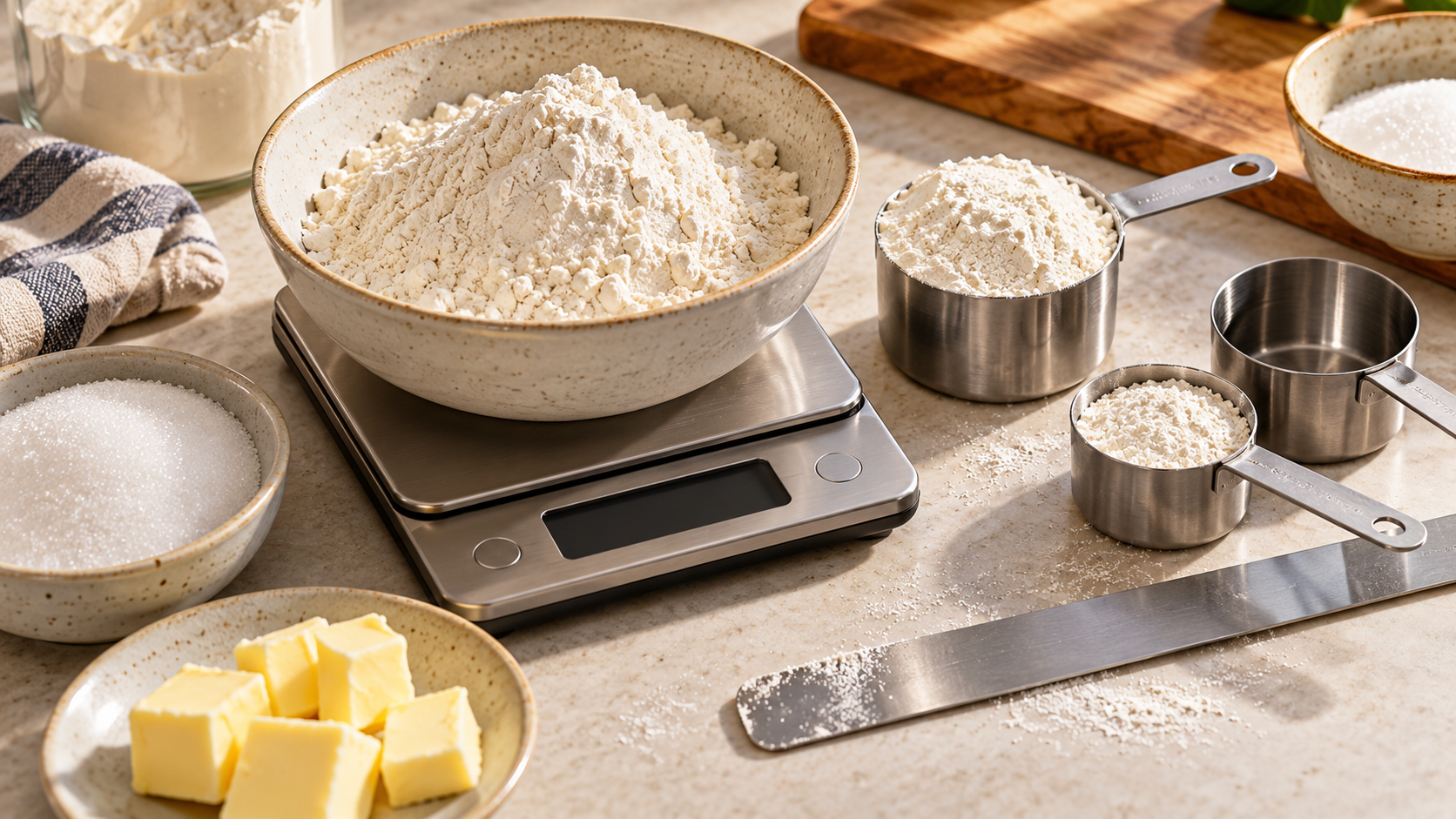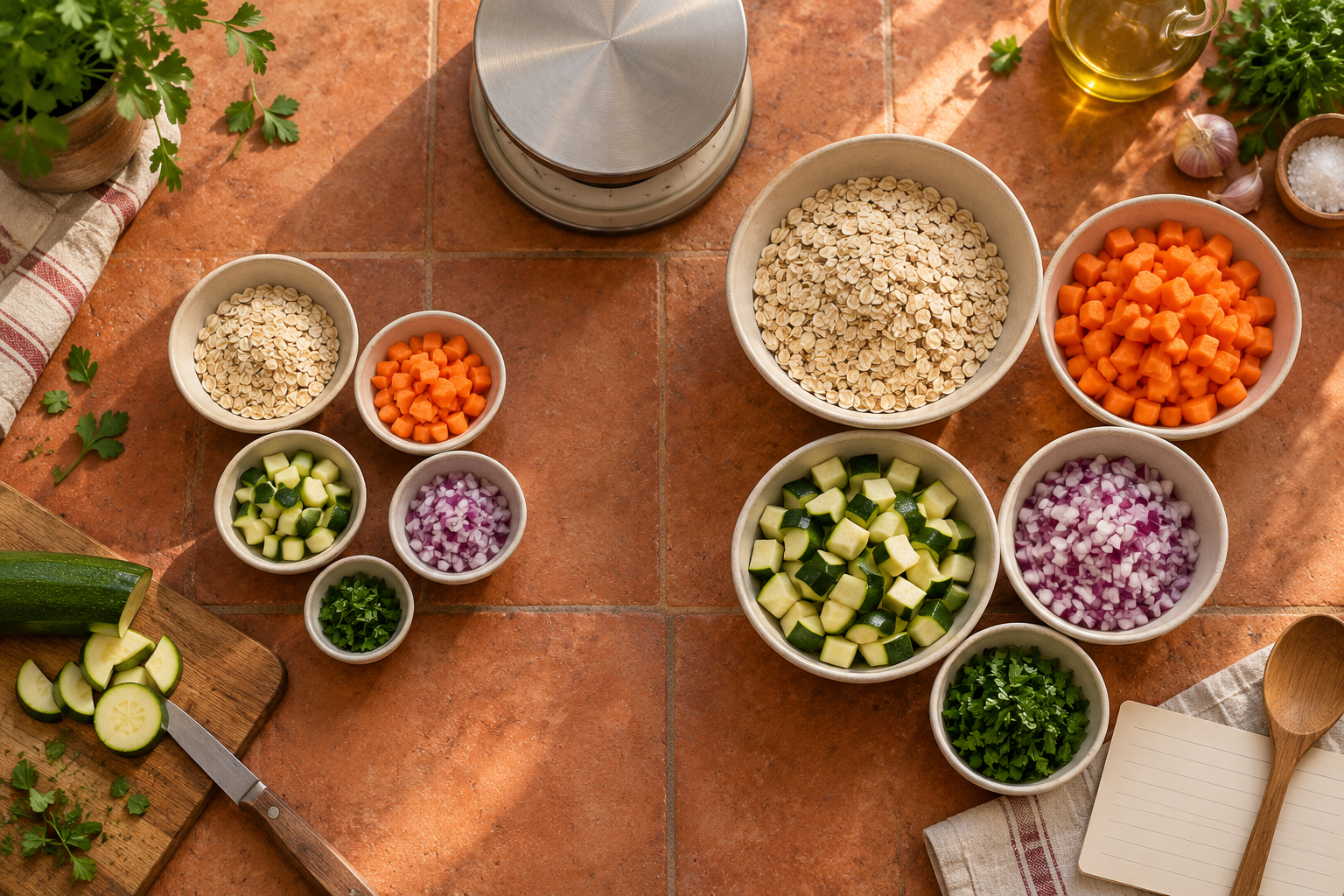
You need nine portions but a recipe makes six, or you want half a batch instead of buying ingredients you will not use. Start with a clear calculation: divide the required yield by the original yield, then multiply ingredient quantities by that factor. The arithmetic does not choose a suitable pan or automatically calculate a correct cooking time.
This guide separates an ingredient worksheet from an execution plan. Its tables and figures are independently constructed teaching examples, not a tested recipe or nutritional recommendation. Use a trustworthy recipe as your starting point and retain its instructions and limits on adaptation. The aim is to make quantities traceable and identify decisions that multiplication cannot resolve.
Define the yield you want to change
A recipe's yield might be a number of portions, a number of equal pieces or a known finished weight. Choose one comparable basis. If a recipe makes six portions and you want nine of the same size, the request is clear. If you also want larger portions, you have changed both size and number; the count alone no longer describes the change.
Write a sentence at the top of your sheet: “Original: six portions of the specified size; required: nine portions of that same size.” This prevents the meaning of a portion from changing halfway through. Do not automatically equate guest count with portion count: define your serving plan without assuming that everyone's needs are identical.
Calculate one scaling factor
Scaling factor = required yield ÷ original yield. Six portions to nine gives 9 ÷ 6 = 1.5. Six to three gives 3 ÷ 6 = 0.5. Six to four gives 4 ÷ 6 = 2/3. Retain a fraction when it is more accurate than a prematurely shortened decimal.
As a quick check, the factor should exceed one when increasing the yield, fall below one when reducing it, and equal one when leaving it unchanged. If you intend to increase the quantity but obtain approximately 0.67, you may have reversed the division. Correct the cause before calculating every ingredient line.
An independent nine-portion example
The following table is a fictional calculation worksheet, not instructions for making a dish. Imagine your source recipe specifies these amounts for six portions. We apply 1.5 to each ingredient line and preserve its original unit.
| Illustrative ingredient | For six portions | Calculation | For nine portions |
|---|---|---|---|
| Weighed oats | 180 g | 180 × 1.5 | 270 g |
| Weighed carrots | 300 g | 300 × 1.5 | 450 g |
| Water measured by volume | 600 ml | 600 × 1.5 | 900 ml |
| Oil measured by volume | 30 ml | 30 × 1.5 | 45 ml |
Do not add gram entries to millilitre entries and call the result a finished weight. The combined ingredients in this example do not represent a measured cooked yield. The calculation describes each line's proportional change; it does not establish that this collection is a balanced or tested recipe.
Reducing quantities uses the same arithmetic
For three portions instead of six, multiply by 0.5. The example becomes 90 g of oats, 150 g of carrots, 300 ml of water and 15 ml of oil. Check backwards: doubling these amounts restores the original column. That verifies the arithmetic, not the cooking result.
For four portions, use 2/3 directly: 180 × 2 ÷ 3 = 120 g; 300 × 2 ÷ 3 = 200 g; 600 × 2 ÷ 3 = 400 ml; and 30 × 2 ÷ 3 = 20 ml. Cutting the factor to 0.66 too early introduces an unnecessary shortfall. Keep precision during calculation and record any rounding at the end.
Separate calculation from practical rounding
Use three amount columns: original, calculated and actually measured. An illustrative 75 g quantity multiplied by 2/3 becomes exactly 50 g. A 100 g quantity becomes 66.666… g. Do not hide the distinction between the mathematical result and what your measuring equipment can deliver.
There is no universal rounding instruction for every ingredient. If the result is too small to measure with your tools, consult the recipe's guidance or choose a workable batch size rather than silently making an arbitrary substitution. The calculation does not establish how sensitive the recipe is to that change.
What about ingredients specified by count?
If scaling produces part of a counted item, put that line in a “decision needed” column. Do not silently replace 1.5 with two, or assume a weight absent from the source. Look for the recipe author's instructions or a reliable version with the yield you need. If the problem remains unresolved, change the batch size or recipe instead of pretending the worksheet is complete.
Units and ingredient descriptions belong together
Retain grams and millilitres as supplied unless you have an appropriate conversion for that ingredient. Cups and spoons are not automatically gram values. If a source specifies a weight after draining or peeling, keep that description on your sheet: it defines the amount being multiplied.
For a weight-based yield, align the yield units before finding the factor. If the original is 1.2 kg of a specified finished product and you require 900 g of the same product, convert 1.2 kg to 1,200 g. The factor is 900 ÷ 1,200 = 0.75. Dividing 900 by 1.2 without aligning the units does not produce a usable scaling factor.
A quantity factor does not determine time or equipment
King Arthur's recipe-reduction guide treats pan choice and baking time separately from ingredient quantities. Do not multiply 30 minutes by 1.5 and announce a validated 45-minute cooking time, or double an oven temperature because you doubled the ingredients.
Keep execution questions on a separate list: does the recipe author provide guidance for this yield; is suitable equipment available; will you make one batch or several? If reliable answers are missing, consider the original batch size following its instructions, including its relevant storage and safety guidance. An ingredient calculator does not supply those instructions.
Plan batches instead of assuming one large container
Suppose you need 18 portions from a recipe yielding six. The overall factor is three. You can multiply quantities by three for a shopping list, while retaining a separate execution sheet for each six-portion batch. In our fictional example, total oats become 540 g, while each individual batch still lists 180 g.
Label “total required” and “per batch” clearly. This helps prevent using the entire total in the first batch. Nor does three batches establish a particular total duration: preparation order, equipment availability and cleanup need their own plan. Keep these logistical estimates separate from exact ingredient arithmetic.
When an available ingredient sets a limit
If the base recipe needs 300 g of carrots and you have 450 g allocated to it, 450 ÷ 300 = 1.5 gives a possible mathematical factor. Check other ingredients and equipment before treating it as an execution plan. Enough of one ingredient does not establish that everything else is available.
You might choose a factor of one instead because another ingredient is insufficient. Write the final factor prominently and recalculate every line with it. Do not leave some quantities from the earlier factor in place: that accidentally combines two different versions of the recipe.
A worksheet that preserves the decisions
- Save the recipe's name, link and consultation date.
- Define original and required yields with their units.
- Calculate the factor and check whether it correctly increases or reduces the yield.
- Copy ingredient descriptions and units, then calculate every line.
- Separate rounded or unresolved quantities from exact results.
- Review equipment, timing and batch organisation using suitable instructions.
- Retain the original and add actual execution notes afterwards.
The recipe-quantity calculator can scale one ingredient amount using original and required portion counts. Repeat it for each ingredient while retaining the unit. It does not test the recipe, choose a pan, set cooking time or assess nutritional suitability.
When sharing your worksheet, include the factor and original yield rather than sending only the final ingredient list. A second reader can then reconstruct the arithmetic and identify which decisions remain open. If you revise the plan, date the new version so that shopping and preparation do not use different copies.
Practical questions
Does increasing portions by 50% mean multiplying by 0.5?
No. A 50% increase retains the original and adds half of it, giving a factor of 1.5. A factor of 0.5 gives half the original. Starting with six portions, the first produces nine and the second three.
Should I start from the original or my last modified version?
Start from a clearly identified version. Returning to the original often makes the factor easier to check and avoids accumulated rounding. If using a modified version, specify its actual yield and quantity basis rather than mistakenly attributing them to the original.
Sources and limits
Vancouver Community College: general scaling principle; its examples were not copied. Recipe Success Guide: retaining source specifications. Recipe reduction guide: separate pan and timing considerations. Consulted 1 November 2026. Our examples and calculations are independent educational material; the generated image is not a measured ratio or tested recipe. This AI-assisted content has not received independent human editorial review.