A woven object's colours may catch your attention before you ask who knows how to make it and how they learned. You might remember the words of a family story but miss the occasion that gives its telling meaning. To understand living heritage, start with the practice and the people explaining it, rather than reducing an encounter to a product photograph or dramatic headline.
UNESCO's intangible-heritage definition connects practices and knowledge with their bearers' recognition of them as heritage. This guide offers questions, a learning notebook and a fictional example. It does not classify a real practice or explain official listing procedures, invent local history or speak for a community.
Learn before choosing an impressive headline
When writing about a practice you know only partly, first identify what you want to understand: how a beginner learns, what requires direct demonstration, or which name practitioners use. These are discussable questions, unlike a ready-made claim about “the last guardian of a tradition thousands of years old” without evidence.
Do not ask someone merely to confirm a story already prepared. Leave room for them to correct your description or explain that the subject is wider than you assumed. The result may be a different title or an account of one learning encounter rather than a claim to describe an entire community's practice.
Separate the object, skill and encounter
Recording a product does not establish that you understand the knowledge behind it. Ask which step you learned and what required explanation or practice. Equally, do not assume every handmade product permits you to call it heritage on its maker's behalf.
Distinguish a short visitor demonstration from continuing instruction or a private occasion. What you saw in an hour may have been selected specifically for explanation. Define the encounter's scope so that a simplified demonstration does not become a description claiming to represent every form or practitioner.
Set documentation boundaries before opening the camera
Explain why you want notes, audio or photographs, who will see them and what you expect to share. Ask what participants prefer to keep unrecorded and respect a refusal of photography. Agreement to attend an encounter is not automatic agreement to publish everything that happens.
The UK living-heritage programme's guidance emphasises community recognition and consent. This is an institutional example within its own context, not a global registration procedure. Our notebook is a personal aid to understanding agreements, not a legal permission form or replacement for arrangements appropriate to a project.
A small notebook showing what you know
| Field | Useful question | How to record it |
|---|---|---|
| Name used | What does the participant call the practice? | Retain the confirmed name without embellishment |
| Encounter scope | Which part was demonstrated or learned? | Specify what you did and did not see |
| Learning | Which step needed explanation or correction? | Describe your experience without generalising |
| Source | Who supplied the information or published it? | Keep the reference and attribution limits |
| Sharing | What may be recorded or shared? | Note the agreement and intended purpose |
| Unknown | What needs further investigation? | Leave a question, not an incomplete fact |
This template was created for the article. Do not fill unanswered fields merely to make the page appear complete. Unnecessary sensitive details can remain outside the notebook altogether. A source field does not require collecting a home address or personal information irrelevant to understanding the lesson.
A fictional example: a short weaving lesson
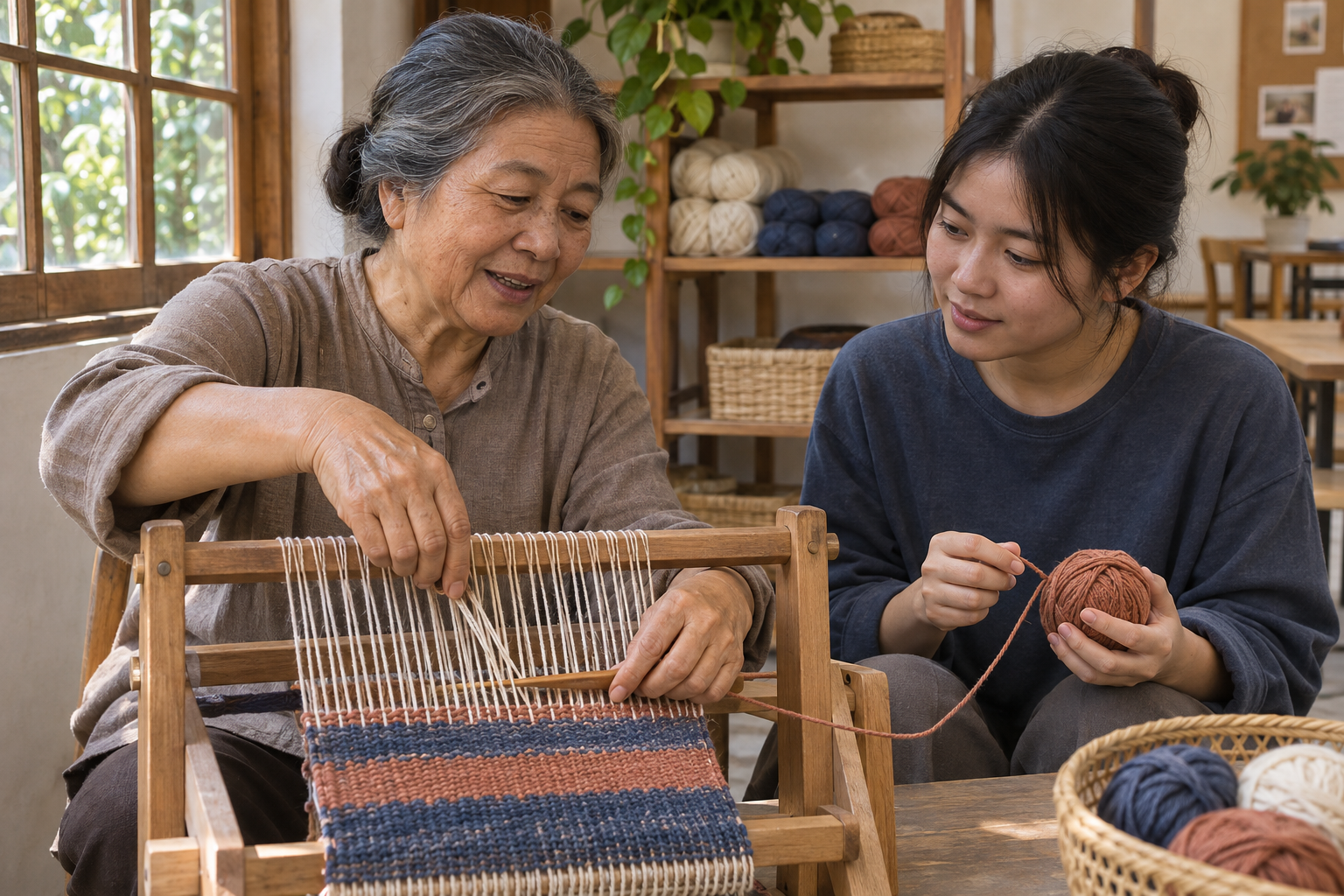
Imagine an educational encounter where one person demonstrates passing yarn through a simple frame to another. The scene belongs to no named country, community or listed practice. The learner initially assumes the finished photograph is enough to repeat the work, then discovers that an unclear movement requires explanation, an attempt and correction.
The note reads: “In this lesson, I needed help understanding the movement's sequence.” It does not say all learners require the same time or that one meeting made the learner a representative of the practice. If the teacher permits a photograph of the sample but not their face, those boundaries remain rather than becoming a portrait under the pretext of documenting heritage.
When describing the encounter, the learner checks the material and method names with the teacher in this fictional case, leaving its history out because it was not researched. The result is an honest account of limited learning, not an invented origin story or a claim that this sample is the only authentic form.
Ask about change without assuming lost value
If two explanations or tools differ, ask what participants say about the difference instead of declaring one genuine and the other fake. You may lack information about their contexts. Record that two methods were described and identify each speaker without turning variation into a broad judgement about people.
Nor should you invent an evolution story simply because a modern tool sits beside an older one. Ask about the relationship and the basis for knowing it. If someone does not wish to discuss that aspect, leave it open instead of filling the gap with a plausible literary paragraph.
Distinguish memory, opinion and documented information
A participant may say they learned from a relative or describe a preferred technique. Attribute that to their experience rather than automatically making it a general community history. If a particular date or origin claim appears, investigate appropriate sources before presenting it as settled.
When accounts differ, record the difference fairly instead of selecting the most exciting version. You can explain that sources give different descriptions and specify your research limits. An introductory article need not resolve every disagreement, and an absent answer never permits an invented quotation, name or date.
Translate names together with context
For another language, do not reduce a term to the nearest available word if that changes its meaning. Retain the name confirmed by the participant or organisation and explain its meaning in context. Where spellings vary, select a documented version and use it consistently between title and captions.
Seek an appropriate check of words attributed to a speaker when expression matters. Do not publish an unclear translation as their direct statement. An explicitly editorial explanation may avoid quotation, but it still cannot introduce a meaning absent from the source.
Do not make the camera more important than participation
Ask whether recording interrupts learning or changes what participants wish to do. Notes after the encounter may be more suitable than requesting repeated movements for a shot. If something was repeated specifically for filming, do not later describe it as a spontaneous event you recorded without intervention.
When using illustration or generated imagery, identify it clearly. Do not attribute depicted people, clothes or forms to a real group without documentation. An expressive image can explain an idea, but it is not evidence that a practice, clothing style or teaching method exists in a particular country.
Review before sharing
- Have you used the correct name and stayed within what you learned?
- Are your observations separate from participants' statements and references?
- Are unresolved questions still visible?
- Do recording and sharing match the agreed purpose and boundaries?
- Have you avoided dramatic labels and undocumented dates?
- Does the image explain what it is without false documentation claims?
- Can readers identify an appropriate source for further learning?
If a paragraph fails these checks, revise it or remove the unsupported claim. A useful story does not need “last”, “oldest” or “only authentic”. A step actually learned, a worthwhile question and fair attribution may be enough.
Return to the people sharing knowledge
Keep a simple version record: draft date, revision and reason for correction. If another account differs, do not silently alter names or attributions to make yours match. Recheck the source and identify what you actually learned. Note when your description concerns one dated encounter rather than all later practice. This helps translation and updates without spreading an old error through many versions.
If you promised a copy or agreed to review a description before sharing it, make that part of the work. Record corrections separately from stylistic edits. Do not turn one person's comment into approval to represent an entire community unless that scope is clear and appropriate.
You may leave knowing your limits better than you know new facts. That is useful: you understand what can be said, what needs research and what cannot be assumed public. Respectful learning remains open to correction and leaves practitioners room to define their own experience.
Sources, image and limits
The two linked pages were read on 2 November 2026. The notebook and weaving lesson are original fictional examples, not a description of a particular tradition or official listing process. The generated image illustrates skill transmission without representing a real community. This content was prepared with AI assistance and has not received independent human editorial review.