You can leave a museum with dozens of photographs and little memory of why you stopped at any object. Or you can see fewer exhibits and leave with a useful question and clearer understanding. The difference does not require being a historian or critic. Start by separating what you noticed yourself, what you read and what remains a possibility.
This guide offers a practical approach to museum and gallery visits, using a small notebook and a fictional example. It invents no artifact's history and explains no unresearched cultural symbols. Practical arrangements differ between institutions, so check the venue's own instructions rather than treating these examples as universal entry or photography rules.
Choose a question to guide the visit
Instead of trying to see everything, identify something that interests you: how signs of use appear on tools, how two objects display the same material differently, or how a room connects several works. The question is not an examination. You can change it when something else deserves your attention.
Select a starting point from the museum map or published collection, then verify that what you want is actually on display. An image in a collection record does not guarantee the object will be in a gallery on your date. If your opportunity is limited, ask the relevant institution about display availability rather than building the entire programme on an assumption.
Prepare a simple way to remember
A small notebook or phone note is enough where permitted. Record the room or display location and the object's name or number when available. The aim is to locate the correct record later, not accumulate long copied passages or pictures whose subjects you cannot identify.
Give a page to an object that raises an important question, not everything you pass. You can write after stepping away if standing there would obstruct others. Save an official record link where available. Avoid collecting visitors' personal details or photographing them as part of your documentation.
Observe before constructing a story
Getty's art-looking resource encourages supporting ideas with visible details. Use that principle without assuming you need every technical term. Describe a line, surface or position in ordinary language, then identify what you cannot distinguish.
“I see a lighter area near the edge” differs from “the owner repaired it after a break.” The first describes what is visible; the second supplies a story needing evidence. A colour difference might have causes you do not know. Retain the observation and do not let the desire for an appealing explanation turn it into historical fact.
Use four notebook fields instead of one impression
| Field | What to write | What to avoid |
|---|---|---|
| Observation | A detail you can point to in the exhibit | Hiding speculation inside a confident description |
| Source | What the label or record states, with a reference | Attributing your inference to the museum |
| Possible interpretation | A provisional idea, its basis and limits | Turning a possibility into confirmed history |
| Next question | A specific fact to research or ask about | An enormous question with no starting point |
This arrangement was created for the article and is not an official museum form. Four short sentences can replace separate fields. When you return to the notes, you can identify where observation ended and interpretation began, and which information came from a text rather than memory alone.
A fictional example: a vessel with different handles
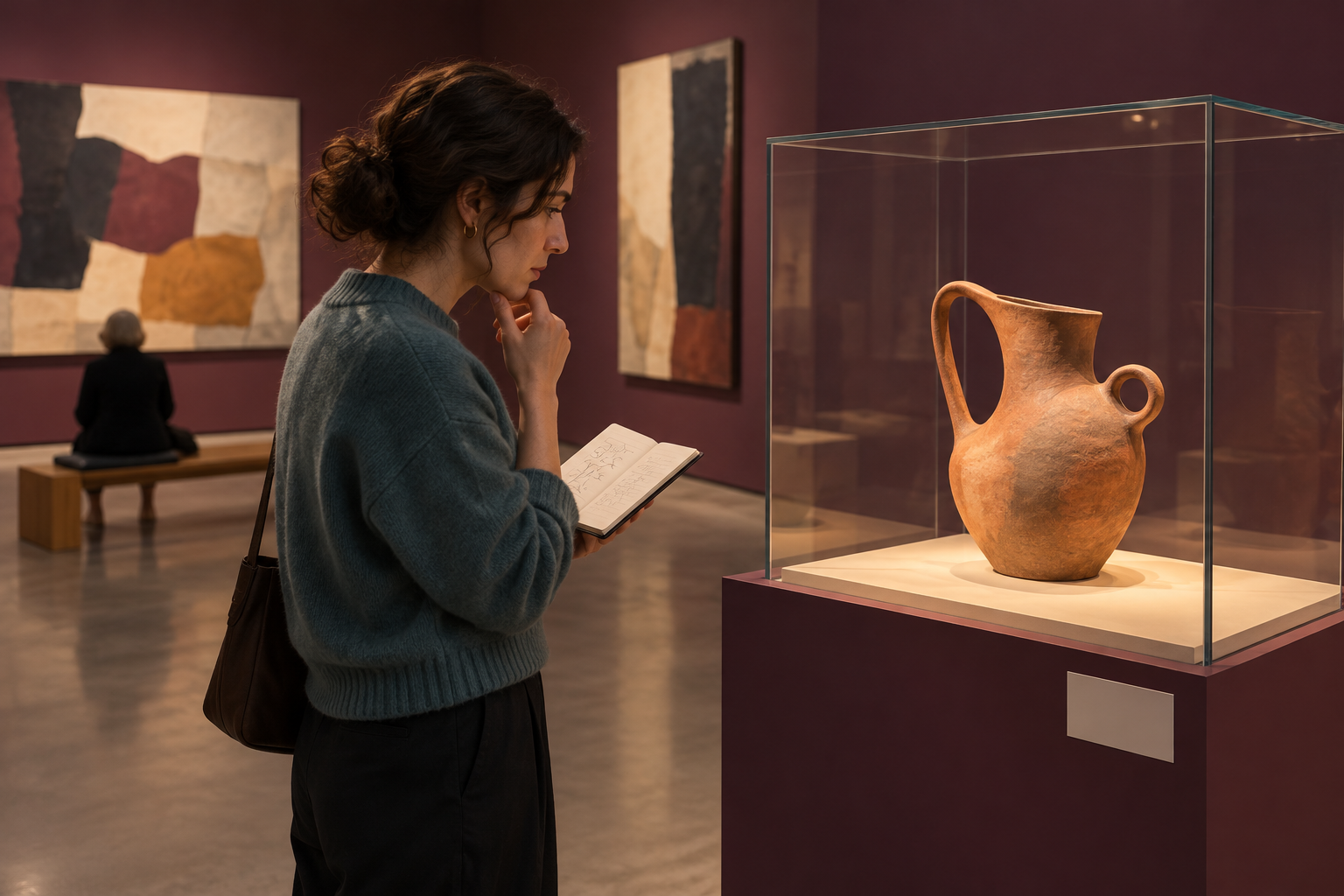
Imagine a vessel with one long handle and one circular handle, assigned to no real period, country or maker. In the observation field, write: “The handles have different shapes.” Do not state that it was designed for two people or a ceremonial purpose. Those interpretations are not established by shape alone.
Suppose the fictional label calls it a “modern experimental model.” Record that as information from an invented label within the exercise, then ask whether a record explains the handles' difference. If it does not, leave the reason unknown. This example quotes no actual museum and claims no real collection contains the object.
Next, compare it with another vessel in the exercise, choosing one aspect: the holding position, rather than only which looks prettier. Note the visible difference without deciding how the objects were used. This produces a researchable question instead of a contest between tastes, while personal preference remains separate from historical claims.
Read the label as a starting point
Identify the fields supplied: title, name or attribution, date or approximate range, material and other information depending on the institution. Do not assume every label follows the same order. If wording indicates estimation or uncertain attribution, retain that qualification rather than deleting it to simplify your note.
An expanded record may supply context that a short label cannot hold. Search using the object's name, number or official link, and check that you have not found a similar work instead. The first general search result is no substitute for verifying the identity of what you actually viewed.
Compare carefully
National Galleries of Scotland's closer-looking resource offers questions about form, technique and context. Choose a suitable focus, then define your comparison clearly. You might examine arrangement or material differences without describing one work as the natural advancement of another.
If two objects come from different periods, do not conclude the earlier one is less advanced because its shape appears simpler. If lighting or presentation differs, note that before comparing colours or apparent sizes in photographs. A useful comparison explains its limits; it does not need a sweeping progress story.
Ask a question that can be answered
Instead of “Explain this whole room,” try a specific request: where can I find more about this object's material? Is there a record explaining this phrase? Is an audio description available for this exhibit? Staff may direct you to a resource without being specialists in every collection detail.
If an answer is unavailable, record the question for later. Do not attribute another visitor's answer to the museum. When noting a spoken explanation, distinguish it from published text and ask for a reference when accuracy matters for an article or study.
Let photography support understanding
Check the gallery's photography policy and follow object-specific signs and instructions. Where permitted, take what helps you revisit your question without disturbing others or crossing barriers. Permission to take a picture does not automatically permit every later use or publication.
A written note may be more useful than a blurred image. If photographing a label for a permitted purpose, connect it with the correct object so descriptions do not migrate between similar pictures. Before later publication, check rights and use conditions rather than assuming a file saved on your phone is unrestricted.
Allow rest and different ways of visiting
There is no required exhibit count for a successful visit. You might choose one section, use an audio resource or return to an object instead of continually moving. Ask about facilities you need and verify their availability at the particular venue, without assuming every branch provides them.
With companions, agree on a meeting point and room for individual curiosity. Everyone need not stop at the same works or reach the same interpretation. Different observations can enrich conversation when opinions remain distinct from claims needing evidence, and those who prefer quiet viewing are respected.
Afterwards, pursue one question
If you encounter an unfamiliar term, retain its surrounding sentence rather than searching the word alone. An institution's glossary may clarify its intended meaning better than a general translation. When using machine translation for a label, keep the original and leave unclear wording open, especially attribution and dates. Fluent translation is not proof of accurate interpretation.
When new information conflicts with your first note, add a correction and source rather than erasing every trace of change. You will see the progression from impression to better information. That is not a failed visit but a useful result of returning to a question, and helps prevent repeating an old idea when sharing images later.
Choose one notebook question and consult a suitable source: a collection record, published museum explanation or specialist reference. Note what it adds and what remains unresolved, retaining its link and consultation date. Not every observation must become a lengthy research project.
When sharing the experience, distinguish what you saw, learned from a source and personally felt. Do not invent a physical visit when writing about a virtual tour or teaching example. Your learning may be a more precise question or a corrected assumption, not a complete story about every exhibit.
Sources and image
The two linked educational resources were read on 1 November 2026. The four-field notebook and vessel example are original material, not the history of a real artifact. The generated image depicts a visitor and invented vessel in an imaginary museum, not an actual collection. This content was prepared with AI assistance and has not received independent human editorial review.