A pack priced at 6 looks cheaper than one priced at 8.80. That tells you which purchase needs less money today, but not which offers more product for the money. To answer the second question, put both products on the same measurement basis, then check whether quantity, delivery charges and realistic use change the decision.
This guide uses invented prices and independently worked examples. The numbers are teaching examples, not current offers, price forecasts or observations of a particular retailer. The currency is deliberately unspecified: replace it with your own currency, keeping the currency and measurement units consistent throughout each comparison.
What unit pricing answers—and what it cannot answer
A unit price expresses cost for a standard quantity, such as a kilogram, litre or individual item. UK government consumer guidance explains this as a way to compare differently sized packs and notes that a larger pack is not necessarily better value by quantity. This article uses that basic principle, without extending UK retail rules to other countries.
The number does not measure ingredients, durability, convenience or suitability. First decide which products can reasonably replace one another. Comparing two sizes of the same product is usually simpler than comparing products with different concentrations or functions. A cheap product that does not meet your requirements is not automatically an economical substitute.
Collect the inputs before opening a calculator
Record the amount you would actually pay and the quantity stated on the packaging. Do not estimate quantity from the height of a container or the size of its photograph. Write down whether the quantity is a weight, volume or item count. Also record any membership, minimum-purchase or coupon condition attached to the advertised price.
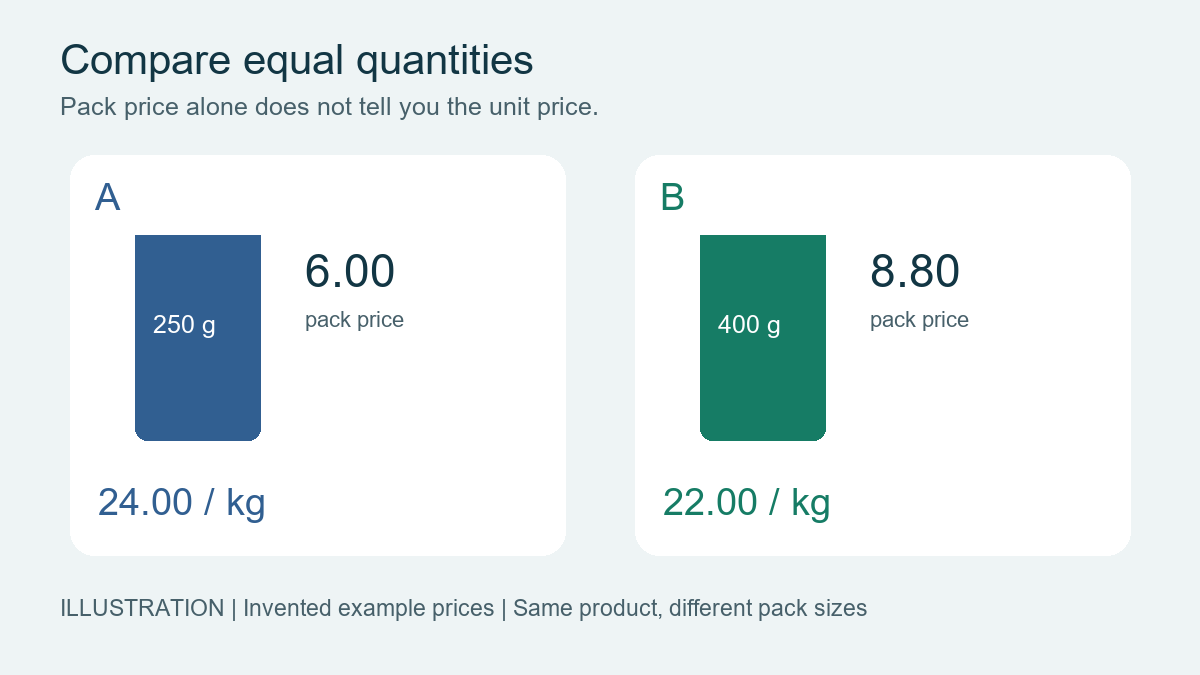
Our starting example compares pack A, containing 250 grams and costing 6, with pack B, containing 400 grams and costing 8.80. We will express both prices per kilogram. That does not mean you must buy a kilogram; it is simply a common scale that makes the two options comparable.
The basic calculation
Price per kilogram = pack price ÷ grams in the pack × 1,000. For price per 100 grams, use 100 as the final multiplier instead. If your quantity is already in kilograms, divide the price by that quantity directly. Keep extra decimal places while calculating and round only the result you display.
| Option | Example price | Quantity | Per 100 g | Per kg |
|---|---|---|---|---|
| A | 6 | 250 g | 2.40 | 24 |
| B | 8.80 | 400 g | 2.20 | 22 |
B costs more at checkout but less for an equal quantity. The difference is 2 per kilogram. Relative to A, the difference is 2 ÷ 24 × 100, approximately 8.33%. That percentage is a comparison between unit prices, not a claim about the money your household will actually save. Your actual spending depends on what you buy and use.
Make the measurement units match
A price per 100 grams and a price per kilogram cannot be compared as bare numbers. Multiply the first by ten, or divide the second by ten, before comparing. For liquid quantities, one litre contains 1,000 millilitres. Convert both quantities to the same unit, then do the division.
Do not automatically interchange weight and volume. A litre of an arbitrary material cannot simply be treated as a kilogram. If one label uses weight and the other volume, find trustworthy equivalent information or leave the direct comparison unresolved. A useful comparison is honest about missing inputs rather than inventing a conversion factor.
A liquid example
Suppose a 750 ml bottle costs 9 and a 1.2 litre bottle costs 13.20. The first costs 12 per litre; the second costs 11. For the first calculation, convert 750 ml to 0.75 litres, then divide 9 by 0.75. Entering 750 into a field labelled litres produces a very small answer, but it is the answer to the wrong question.
When comparing by item makes sense
If the individual items are equivalent in size and purpose, divide the total price by the number of items. A pack of 12 costing 18 is 1.50 per item. A pack of 20 costing 28 is 1.40 per item. If the items have different sizes or functions, the lower cost per item may not describe equivalent value. Look for a meaningful common quantity or task instead.
Be careful with advertised numbers of uses. If you calculate cost per use from a number on a label, identify that number as an assumption behind the calculation. Actual use may differ. Follow product instructions and do not change a dose or method of use just to make the arithmetic look cheaper.
Apply discounts to the price before calculating the unit cost
Give pack B from the first example a hypothetical 15% discount. The discounted price is 8.80 × 0.85 = 7.48. Its price per kilogram becomes 7.48 ÷ 400 × 1,000 = 18.70. Compare that figure with the alternative's current price, rather than an older price you remember seeing.
Do not deduct the discount again if the displayed price already includes it. A membership price is not automatically available to someone who has no membership. Record conditions separately so that a conditional offer is not silently treated as a price every shopper can obtain.
Successive percentages are not simply added
A 20% reduction followed by 10% off the remainder leaves 0.80 × 0.90 = 0.72 of the original price. The total reduction is therefore 28%, not 30%. Starting at 100, the price becomes 80 and then 72. This explains the arithmetic of successive discounts; it does not establish that a retailer permits two promotions to be combined.
Separate the multibuy calculation from the need to buy more
For three packs at the price of two, calculate the total quantity received and the total amount paid. If each pack contains 500 grams and normally costs 10, paying 20 for three packs buys 1.5 kilograms. The resulting unit price is approximately 13.33 per kilogram. That assumes the packs are identical and the promotion applies as described.
It does not follow that buying three is the right decision for every shopper. If you only need one and cannot use the remainder, a lower unit price may increase spending without adding useful value. Ask two separate questions: is the price lower for an equal quantity, and can I use this quantity within my budget and available storage?
Include the costs that belong to the purchase
The US Federal Trade Commission advises online shoppers to compare total cost, including relevant charges, and examine the conditions of an advertised deal. Here we apply that general shopping principle to invented calculations, not to a country's tax rules or legal rights.
A one-kilogram pack costing 20 plus delivery of 7 creates a total of 27 for that purchase. An equivalent pack costing 24 with no delivery charge could therefore be the cheaper order. If several items share one delivery charge, do not assign the whole charge to every item. Compare complete baskets, or disclose and consistently use an allocation method.
Free delivery does not necessarily mean a smaller total
Imagine a basket costing 42, a delivery fee of 6 and free delivery once the basket reaches 50. Adding an unnecessary item costing 9 produces a total of 51. Keeping the basket unchanged costs 48 including delivery. Avoiding the delivery line has increased the total in this example. If you already needed the additional item, the comparison would be different.
Compare useful quantity when waste matters
You can explore waste with a transparent scenario instead of pretending to know a household's future consumption. Suppose you pay 20 for one kilogram but use only 750 grams. The effective cost per kilogram used is 20 ÷ 0.75, or about 26.67. If you instead pay 18 for 750 grams and use all of it, the effective cost is 24 per kilogram used.
Under those particular assumptions, the smaller pack is the better purchase even though its label price per kilogram exceeds the larger pack's label price. This is not a measured waste rate, and it is not a reason to use unsafe food. Follow storage and date instructions. Where future use is uncertain, show more than one scenario and name the assumptions.
Today's budget is a separate constraint
A larger pack can have a lower unit price while requiring more money than you can spend today. Do not let the calculator turn a comparison into pressure to buy unaffordable quantities. You can note the lower unit price as a possible future option and choose a smaller purchase that fits the present budget.
There is also a difference between evaluating a needed replacement and inventing a reason to shop. If you already have a suitable product, buying a discounted alternative does not create a saving merely because its price is attractive. Use the comparison to answer an existing purchasing question, not to create a new need for every promotion.
A practical comparison sheet
- Define the purpose and the features that must match.
- Record the available price, quantity and measurement unit.
- Convert the quantities to the same unit before dividing.
- Write down membership, coupon and delivery conditions.
- Consider how much you can realistically use, marking uncertain estimates.
- Check the amount due today against the budget and record why you chose the option.
Use the unit-price calculator when both quantities use the same unit. The discount calculator can help determine a reduced price. Neither tool verifies whether products are equivalent or labels are correct. If a price or quantity changes, repeat the calculation instead of reusing an old result.
Questions that expose misleading comparisons
Is the larger pack always cheaper?
No conclusion follows from size alone. Calculate the actual unit price and then consider the amount you need. Our starting example favoured the larger pack, while the waste scenario favoured a smaller purchase because the assumptions were different.
Should taxes and fees be included?
For a comparison of what you will pay, use a consistent basis that includes applicable costs. Do not compare an all-in price with a price excluding charges. If the final cost is unknown, mark the result as unresolved rather than declaring a certain winner.
What if the quantity is unclear?
Look for a reliable product description or ask the seller. Do not estimate weight from a photograph or treat an unsupported marketing statement as a neutral measurement. You may compare the total prices while clearly stating that comparable unit costs could not be established.
Sources and editorial limits
We consulted the UK government unit-pricing guide and the FTC online-shopping guidance on 30 October 2026 for the general measurement principle and total-cost comparison. The examples, tables and calculations in this article are independently constructed, not prices reported by those sources or results from a market survey. This AI-assisted content has not received independent human editorial review.