You might see dozens of organisms in one place, then fewer in another place but belonging to more species. Which is more diverse? Before answering, we need to establish what we counted and where, when and how we observed it. A large collection of pictures or sightings does not provide a complete description of biodiversity, and a green landscape is not a scientific certificate of its condition.
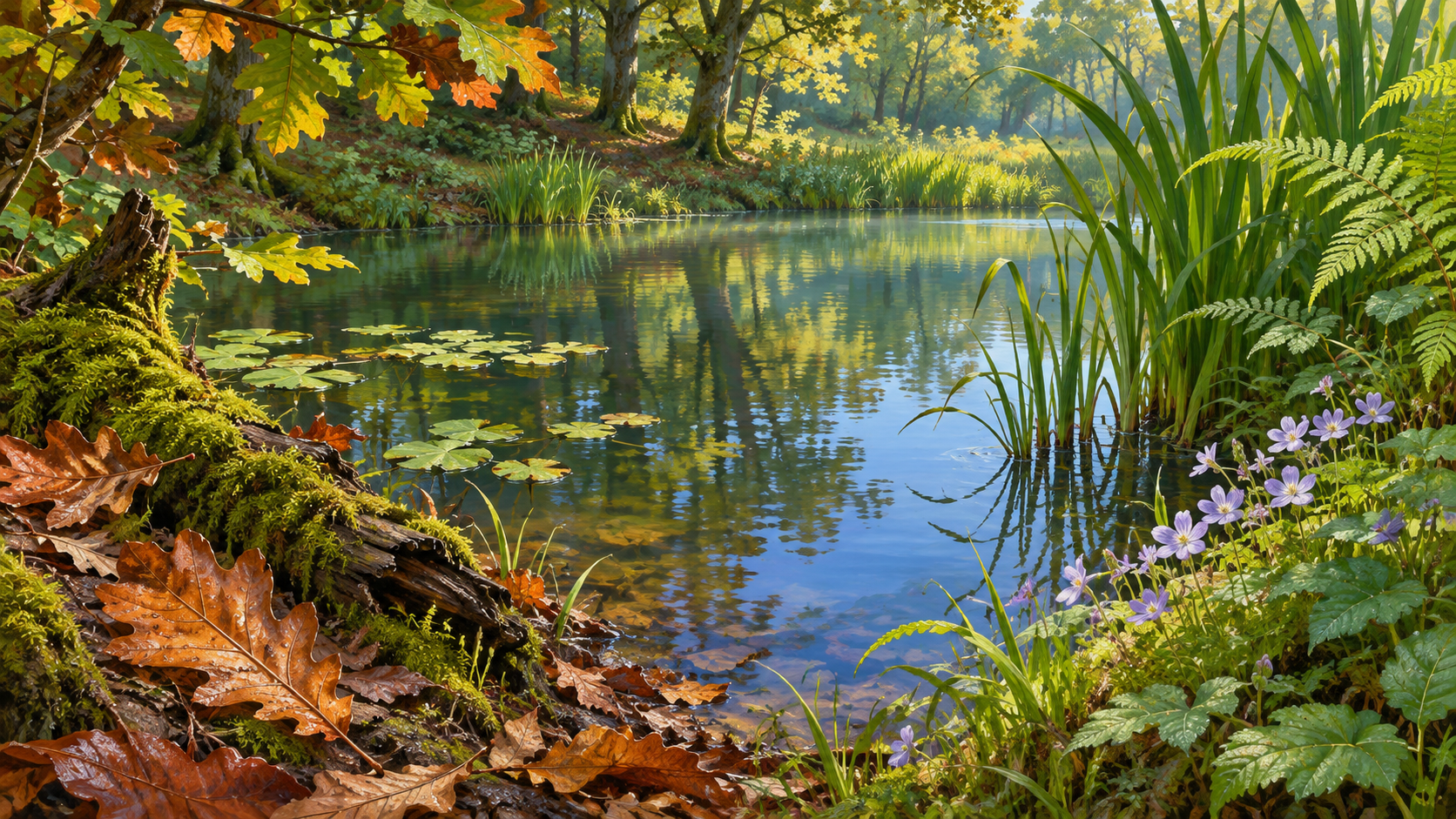
This guide explains how to think about diversity and read a simple observation record without drawing conclusions larger than its evidence. Every table, site and count below is an original teaching example, not a field survey or the identification of real species. The accompanying generated image depicts an imaginary scene; it does not document a particular organism or demonstrate ecosystem health.
Biodiversity is broader than a list of names
The Convention on Biological Diversity Secretariat's guide describes diversity within species, between species and among ecosystems. The idea therefore extends beyond counting familiar animal names.
Organise your questions by level instead of mixing them together. Are you asking which species were recorded in a garden, investigating variation within a species, or discussing different environments across a region? Each question needs suitable evidence. A picture of two differently shaped plants may prompt a question about their identities, but it does not by itself measure genetic differences or establish that they belong to separate species.
This distinction also helps when reading. If a report has a broad title about diversity, look at what it actually measured. It may count a particular group at particular sites, rather than all organisms or every aspect of diversity. You can value the work while keeping its boundaries visible. A useful study does not have to measure everything.
Separate individual counts from recorded species counts
Imagine a teaching table in which identities and counts are assumed known and every individual is counted once. A, B and C represent three fictional species, not names to search for in a field guide. We make that assumption to focus on counting, then return to the complications of real observations.
| Fictional species | First site | Second site |
|---|---|---|
| A | 4 individuals | 10 individuals |
| B | 4 individuals | 1 individual |
| C | 4 individuals | 1 individual |
| Total | 12 individuals from 3 species | 12 individuals from 3 species |
Both totals are 12 and both recorded species counts are 3, but the distribution differs. At the first site, each species represents 4 of 12 individuals, or one third. At the second, species A represents 10 of 12, approximately 83.3%. Having the same total and the same species count therefore does not mean the records have identical composition.
We do not turn this into a verdict that one site is better or healthier. We have not described either environment, the observation period or an ecological question to answer. The point is to name your measure rather than simply saying “more”. You can state that individuals are equally distributed among the three species in the first table without claiming a comprehensive ecosystem assessment.
Pictures, records and individuals are different units
If someone takes five photographs of the same organism, we have five photographs, not five established individuals. If an application exports the same record twice, that does not create two independent observations. Before adding numbers, state your counting unit: pictures, records, distinguishable individuals or identified species.
In another exercise, suppose there are 8 image files, including 3 extra copies of images already present. Removing those extra copies leaves 5 distinct files. It does not establish 5 individuals, because different pictures could still show the same individual. Cleaning the files answers a duplication question; it does not automatically resolve organism identity.
If individuals cannot be distinguished, say so. “Observed repeatedly” is more accurate than converting repeated sightings into a confirmed individual count. Do not erase original records simply to make the file look tidy. Preserve why a record was considered a duplicate and what remains uncertain so that someone else can understand the decision.
Record observation context before comparing results
GBIF's dataset-class documentation distinguishes occurrence records from sampling-event data, whose information about methods and effort supports comparisons.
For a simple personal exercise, create a record with an appropriate location description, date, observation start and finish, the group you are looking for, your method and identification limits. You do not need to publish exact coordinates to learn how to organise your observations. When participating in an established project, follow its fields and protocol instead of inventing an incompatible replacement.
Suppose a first record contains 6 species observed over 15 minutes, while a second contains 9 over 45 minutes. You can accurately say the second contains more names under different observation effort. Do not divide the counts by minutes and treat the result as a standardised measure of site quality: this table does not establish how observation time relates to what is detected.
Not seeing something is not a final answer about absence
Distinguish “did not search”, “searched but recorded no sighting” and “saw something I could not identify”. Combining all three as zero hides useful information. A zero can be a count within a specified attempt, whereas a blank could mean missing data or work that was never carried out.
If species B is not recorded on a later visit, describe the boundaries of that observation before interpreting it. Did the visit cover the same area and target group? Were methods comparable? Do not jump from a short personal record to a claim of local extinction or established change. An observation can raise a useful question requiring follow-up without answering it conclusively.
Keep identification confidence visible
Keep confirmed names separate from unresolved suggestions, or mark uncertainty clearly. If two pictures may show the same species, do not add two names just to lengthen the list. Conversely, do not merge different records merely because their colours look similar. Visual resemblance can begin an investigation; it is not a sufficient rule for every case.
In our fictional example, if C's identity is unresolved, describe the result as two identified species and a third record needing identification, rather than three confirmed species. Retain the original, the change and its reason if the identification is revised later. The aim is a reviewable record, not a list that looks certain regardless of evidence.
How to read a claim that diversity increased or declined
Start with the counting unit, period, location and target group. If a platform's record count rose, did participation increase or the reporting method change? That is an alternative question to investigate, not a ready-made explanation for every increase. Do not automatically equate database growth with growth in organism numbers.
Also check whether the study discusses recorded species counts, individual abundance or a combined index. Do not transfer a percentage change in one to another. When sufficient detail is unavailable, the appropriate conclusion is that the presented evidence does not let you compare, rather than choosing whichever direction makes a more dramatic headline.
A structured observation exercise without disturbing the site
- Write a narrow question, such as organising visible plants along an accessible path, instead of attempting to inventory all life.
- Define the area, period and method beforehand, and record any later changes.
- Observe from an accessible place without collecting organisms or altering habitat for a picture or result.
- Record what you saw and what remains unidentified; do not add expectations to observations.
- Review duplication and counting units, preserving originals and explanations of changes.
- Write a conclusion describing this record and its limits, followed by a question needing further work if one emerges.
This is an educational way to organise observations, not an approved survey protocol or permission to enter or collect. If your question requires identification expertise or study design, work with an appropriate specialist or scientific project. You do not need a dramatic conclusion for a careful observation to have value.
Questions that help prevent premature conclusions
Is a green-looking site enough?
A picture can help describe a scene, but it does not supply a documented inventory or measure every level of diversity. State what is actually visible and keep aesthetic impressions separate from conclusions requiring data.
Can two lists simply be added to count species?
If the first contains A and B and the second B and C, adding their entry counts gives 4, while their combined unique names number 3: A, B and C. First establish that names refer to equivalent units, then remove duplication as appropriate to your question.
Reading biodiversity clearly begins by naming what we know and what we did not measure. State the unit, context and confidence, then keep conclusions within those boundaries. These habits make even a small record understandable and reviewable, preventing large numbers from concealing the basic questions.