“The task took five minutes” sounds clear, but it can conceal important questions. When did timing begin? Did it include preparing the equipment? Was the timer paused during an interruption? Does the notation really mean five minutes? Useful duration measurement starts by defining what counts, then choosing a tool and recording method that another person can understand.
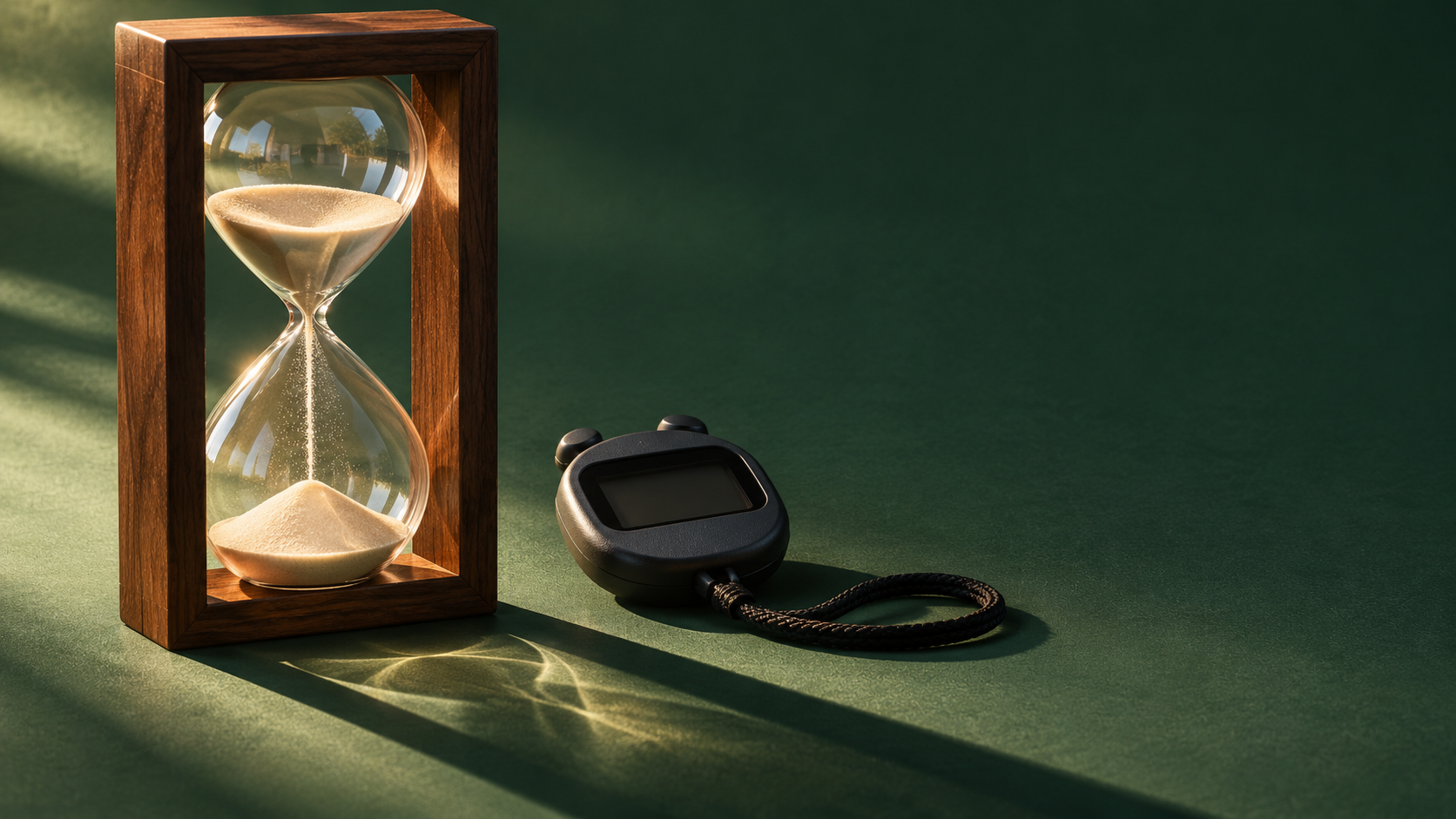
This guide uses independent arithmetic examples to explain intervals, repeated attempts and cumulative readings. They are not results from an experiment we performed, product comparisons or a calibration certificate. The generated image shows an hourglass and a blank-screen timer, not a measured interval. This AI-assisted content has not received independent human editorial review.
Distinguish when something happened from how long it lasted
“Work began at 10:02:15” identifies an instant within a date and time reference. “Work took 270 seconds” describes an interval. Compatible timestamps can yield a duration, but subtracting readings from two unexplained clocks does not automatically produce a reliable measurement.
Assume the same clock and day, with no clock adjustment during the task. A start of 10:02:15 and end of 10:06:45 give four minutes to 10:06:15, followed by thirty seconds: 270 seconds altogether. Preserve these assumptions when explaining the calculation. For a real record, do not conceal a changed date or clock setting.
The International Bureau of Weights and Measures defines the second as the SI unit of time. Knowing the unit does not mean every device displaying it automatically has the accuracy of a scientific reference. The unit and the quality of a particular measurement are different matters.
Define the start and finish events before pressing a button
For a low-stakes paper exercise, suppose you want the time required to arrange five cards. Do you start when the instruction is heard or when the first card is touched? Do you finish when the last card is placed or after checking the arrangement? Different definitions may answer different questions, but switching between them makes comparisons unclear.
Write an observable definition: “Start when the first card is touched; finish when the last card rests in its required position.” Then state whether checking the result belongs to the task. This is an example of defining a measurement, not an actual human study or a standard for assessing people.
A complete service-time question may include preparation and waiting. A question about one step needs the boundaries of that step. Do not call either number universally more correct without returning to the question you are trying to answer.
Do not read minutes and seconds as a decimal number
When 1:30 means one minute and thirty seconds, it equals 90 seconds or 1.5 minutes. Decimal 1.30 minutes instead equals 1.30 × 60 = 78 seconds. The difference is twelve seconds despite the similar notation. Use unit names or explicit column headings instead of depending on a colon or decimal separator alone.
Likewise, four minutes and thirty seconds equals 270 seconds or 4.5 minutes, not 4.30 minutes. When moving data into a spreadsheet, check what a cell represents before calculating. It may contain a time of day, duration or text; its appearance alone is insufficient.
Converting manual records to seconds first can simplify comparison, then you can display the result as minutes and seconds. Keep the original reading so a transcription mistake can be traced instead of reconstructing the record from memory.
Separate total elapsed time from active task time
Imagine a teaching session lasting nineteen minutes from beginning to end, including three minutes of interruptions. If active time is defined as total time minus interruptions, it is sixteen minutes. Do not remove interruptions from the entire report: show nineteen elapsed, three interrupted and sixteen active minutes with your definition.
Active time is not better for every purpose. Someone awaiting delivery may care about the whole elapsed interval; someone reviewing a step may care about its execution time. Reporting both prevents a changed definition from looking like improved performance.
If an interruption was not recorded, do not invent its length to make the numbers fit. Mark the gap in the record and limit the attempt's usefulness for your question. An honest incomplete record is more useful than apparent precision unsupported by observation.
Understand cumulative readings before calculating stages
A timer might show each stage separately or the cumulative time since the start. Check the display's meaning in the tool's instructions before writing down a “lap”. The invented table below assumes cumulative readings and no pause between marks.
| Mark | Cumulative reading, seconds | Stage duration |
|---|---|---|
| First | 42.4 | 42.4 − 0 = 42.4 |
| Second | 87.1 | 87.1 − 42.4 = 44.7 |
| Third | 132.9 | 132.9 − 87.1 = 45.8 |
The stages total 42.4 + 44.7 + 45.8 = 132.9 seconds, matching the final cumulative reading under these assumptions. Adding the cumulative readings themselves counts parts of the interval more than once. This checks the table's arithmetic, not the timer's accuracy or the correctness of the chosen events.
Displayed digits do not establish measurement quality
The 2019 NIST procedure for calibrating timing devices identifies operator response and display resolution as uncertainty factors. We cite the principle only, not transfer a calibration procedure to this home exercise or claim laboratory compliance.
A screen showing 58.800 seconds does not prove your start and stop actions were timed accurately to a thousandth of a second. Extra digits can be part of display formatting. Assessing a result requires knowledge of the tool, method and limitations, not simply more digits after the decimal.
Do not invent one universal error allowance for every person and device. If a task requires documented accuracy, use the appropriate specialist method and reference. This article provides no calibration certificate and no instructions for opening or adjusting an instrument.
Repeat with a fixed definition without treating the mean as exact truth
Three hypothetical attempts with compatible definitions last 58.8, 59.4 and 59.1 seconds. Their sum is 177.3, mean 59.1, and range 59.4 − 58.8 = 0.6 seconds. These values summarise the example. They do not prove a true duration of exactly 59.1 seconds.
Variation could combine differences in task execution and button timing. Do not attribute it to one factor without a design that supports that inference. Nor is the range alone a complete uncertainty budget or a guarantee that every future attempt will fall inside it.
Keep an unusual attempt and its note instead of deleting it because it contradicts the preferred result. You can distinguish an attempt completed under the definition from one disrupted by a documented interruption, but explain the rule. Do not invent it after seeing the numbers to make the result look better.
A checklist for a record you can understand later
- What question is the duration intended to answer?
- What exact events define the start and finish?
- What tool and unit are used, and is the reading cumulative?
- Are preparation and interruptions included?
- Do you preserve each attempt and its notes before calculating summaries?
- Do you distinguish actual observation from an example or estimate?
This does not require names or private personal information. For a simple learning exercise, identify the task, version and method. Do not turn a limited exercise into a broad judgment about a person's competence or a product.
Questions about comparison and conclusions
Does agreement between two timers establish that both are correct?
It shows agreement in the specified comparison, not by itself the validity of the reference or operating method. The timers might share an assumption or error source. Record the result and limits without calling it accredited calibration.
Can I compare attempts made with different definitions?
You can describe them, but do not present them as one consistent measure without explaining the difference. If one includes preparation and the other excludes it, the apparent change may come from the definition. Align the question and method before claiming improvement or deterioration.
References and scope
The BIPM second page and linked NIST procedure were read on 2 November 2026. Numbers, the card task and the table are independent examples, not observed or calibrated results. We have not reproduced telephone numbers, tolerances or laboratory steps from the 2019 document. This article does not guide a medical or industrial decision, or an activity requiring certified timing.