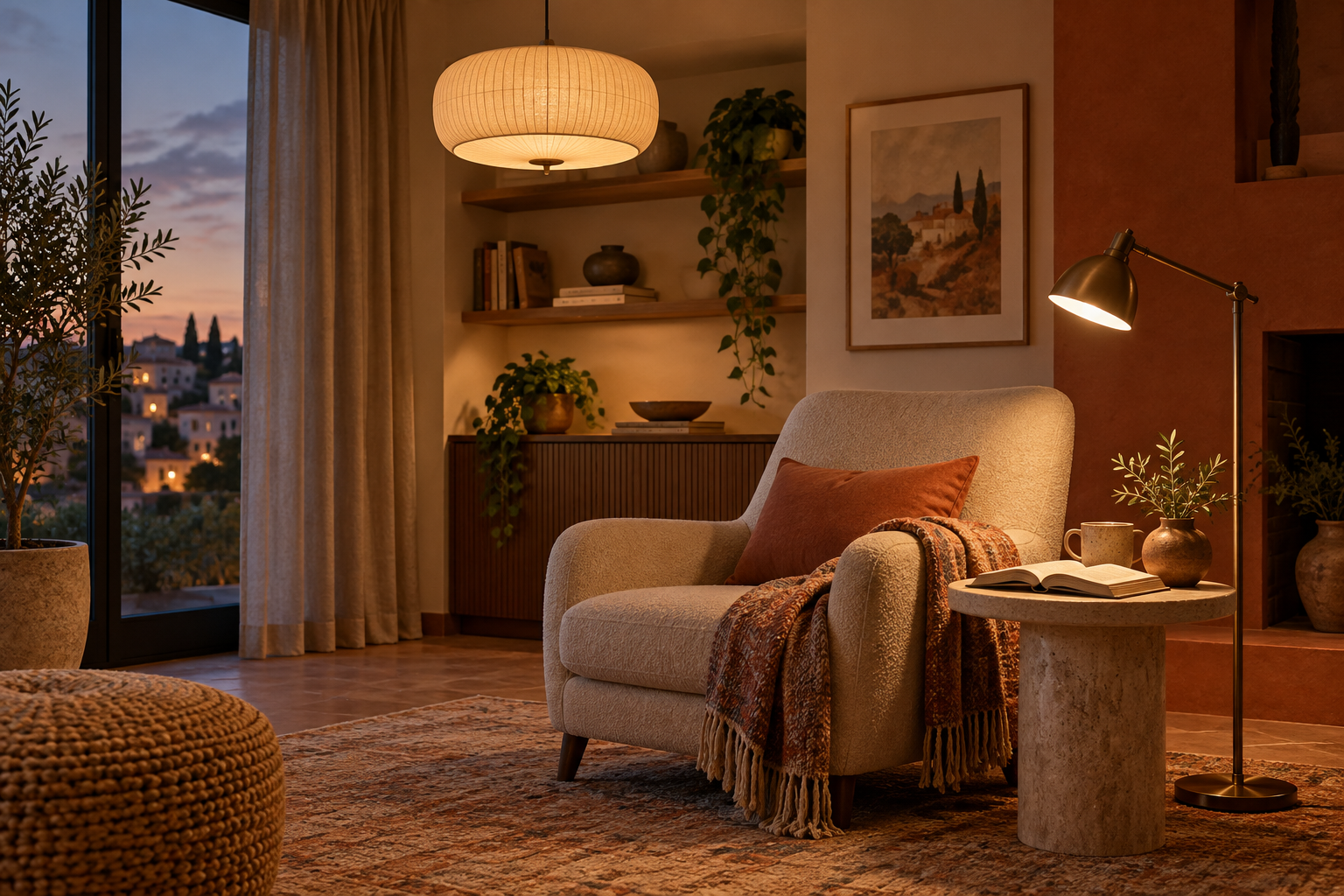
Choosing home lighting starts with a simple question: what will you do in this space? A lamp that looks attractive in a photograph may not help you read, and a stronger ceiling light may still leave your work in shadow. A useful decision connects the activity, the position of the light and the product specifications before considering compatibility and cost.
This guide offers a practical comparison method. Its shopping scenarios and calculations are hypothetical examples, not results from physical product testing. It does not provide a universal lighting target for every room or instructions for electrical work.
Map the activities before making a shopping list
Sketch the room and mark the sofa, table, desk and windows. Next to each area, write what actually happens there: reading, conversation, watching a screen or a craft activity. You do not need an engineering drawing to choose a reading lamp, but you do need to know where the person and the task will be. Record the time of use as well.
The Australian government’s YourHome guide discusses general lighting, task lighting, placement and daylight.
Turn those categories into a working sheet: light for moving around, light for a specific activity, and optional light for a feature. The last category is not compulsory. In a fictional living room with a sofa, reading chair and wall picture, general lighting and a reading lamp might come before lighting the picture. That order keeps decorative spending from displacing a practical need.
Keep output, power and appearance separate
The FTC distinguishes lumens, which describe light output, from watts, which describe power use.
The Energy Rating guide covers colour temperature, colour rendering, fitting details and compatibility.
| Item on your worksheet | Question to record | Comparison mistake to avoid |
|---|---|---|
| Output | What lumen figure does the product list? | Comparing only the largest wattage |
| Power | What power figure accompanies that output? | Treating different outputs as equivalent |
| Appearance | What colour specification do I want to try? | Relying on the word “white” alone |
| Suitability | Has the supplier confirmed the intended fitting? | Guessing from the shape in a photograph |
Consider three fictional options. One lists 800 lumens at 8 watts; another lists 800 lumens at 10 watts. Their stated output matches, while the first uses less power according to those figures. That does not automatically make it the right purchase: size, compatibility, appearance and warranty still matter. A third option offering 1,200 lumens at 10 watts changes the output, so it is no longer a straightforward substitute.
ENERGY STAR advises comparing the required lumens first and then the watts.
On your shortlist, highlight the actual specifications before relying on a familiar “equivalent to” phrase. Ask the retailer to explain any comparison that seems unclear. Keep the answers with the product name so you can identify the exact version later.
Choose the appearance through a specific trial
Describe the scene you want rather than choosing a label in isolation: an evening conversation area or a worktable where you want to see details comfortably. Compare suitable options in the intended location when the retailer’s trial or return policy permits. Let the person who will use the space judge the result rather than relying only on a phone photograph.
If two lamps will be visible together, record both colour specifications before buying. An unintended difference is easier to avoid when the details are written down. Conversely, identical lighting throughout the house need not be a goal by itself. You may prefer different results in different spaces. This is a way to organise preferences, not a claim about a particular health effect.
If the appearance of fabrics or artwork is important, make that a separate question for the supplier and ask for relevant product information. Do not assume that a marketing expression such as “natural light” answers every question about how the objects will look. Record what remains uncertain and decide whether an actual trial is needed.
Review the position before buying a stronger light
Sit where you normally read and put the book in its usual position. Describe the problem precisely. “I can see the source directly when I lean back” gives a clearer brief than “the lighting is bad.” Likewise, “my hand blocks the light over the writing area” is more useful than “I need a bigger lamp.”
These observations help a retailer or lighting professional understand the use case. They are not a reason to alter wiring or reach into electrical parts. Keep the trial within the normal, instructed use of the existing equipment.
A simple trial sheet
- Choose the usual seat and place the book or activity where you actually use it.
- Record the experience with general lighting, then with the suitable task lamp used according to its instructions.
- Note whether a visible source or reflection on a page or screen bothers you.
- Ask another regular user to record their own observations.
- Keep the specification and return terms, then decide before buying several identical units.
This is a personal suitability check, not an accredited lighting measurement. If the project needs precise lighting calculations, prepare the layout and activity requirements for a professional. A shopping list and a few observations do not constitute a complete lighting design.
Resolve compatibility questions before paying
Keep a clear photograph of the existing fitting’s information or its manual. Ask for confirmation that the proposed product is suitable for that specific equipment. If a control system is involved, identify it rather than relying on a broad description in an advertisement. An unanswered compatibility question should remain visible in your comparison sheet.
Write down the practical questions: Are there usage restrictions? Who supplies a replacement if it fails? Is the light source replaceable or integrated into the unit? What does the warranty cover? Avoid guessing from appearance alone. Changes to wiring, fixed installations or electrical faults belong with a qualified professional.
Calculate running cost with explicit assumptions
Our example uses invented prices and does not represent any country’s tariff. Suppose four lamps, each rated at 8 watts, operate for five hours daily over 30 days. Their combined power is 32 watts. Calculated consumption is 32 × 5 × 30 ÷ 1,000 = 4.8 kilowatt-hours for that period.
At an assumed price of 0.20 currency units per kilowatt-hour, the consumption-related cost is 4.8 × 0.20 = 0.96 units. Fixed charges, taxes and tariff bands are not included. Replace the assumptions with your actual billing information and realistic operating hours, and name the currency used.
For comparison, four 10-watt lamps used for the same time consume 6 kilowatt-hours and cost 1.20 units under the same assumption. The difference is 0.24 units for this period. That does not prove that a higher purchase price will pay back quickly. Compare purchase price, expected use, warranty and replacement cost before making a longer-term claim.
A decision record for each room
- Main activity: name something people actually do.
- Current problem: describe the location and situation.
- Shortlisted specification: record the exact product details.
- Control: note the function you need and what has been confirmed.
- Cost: separate purchase, running and possible replacement.
- Trial decision: state what would make you keep or return the option.
Questions that help finish the decision
Should I buy for the whole house at once?
If the result is uncertain, start with a frequently used area and review the choice before repeating it. Keep the product name, location, purchase date and users’ comments. This helps you repeat a successful choice without accidentally buying a specification you previously disliked.
Is there one correct value for every room?
This guide does not prescribe one. Ask anyone proposing a product to explain the assumed seating position, furniture layout and other light sources. A recommendation tied to a clear activity is easier to evaluate than a suggestion to buy the highest available power.
When should I seek professional help?
When the task becomes a new design, a fixed installation or an electrical problem, provide your needs, budget, photographs and product instructions to the appropriate professional. Your comparison sheet explains the brief; it is not permission to attempt electrical modifications.
Sources and editorial transparency
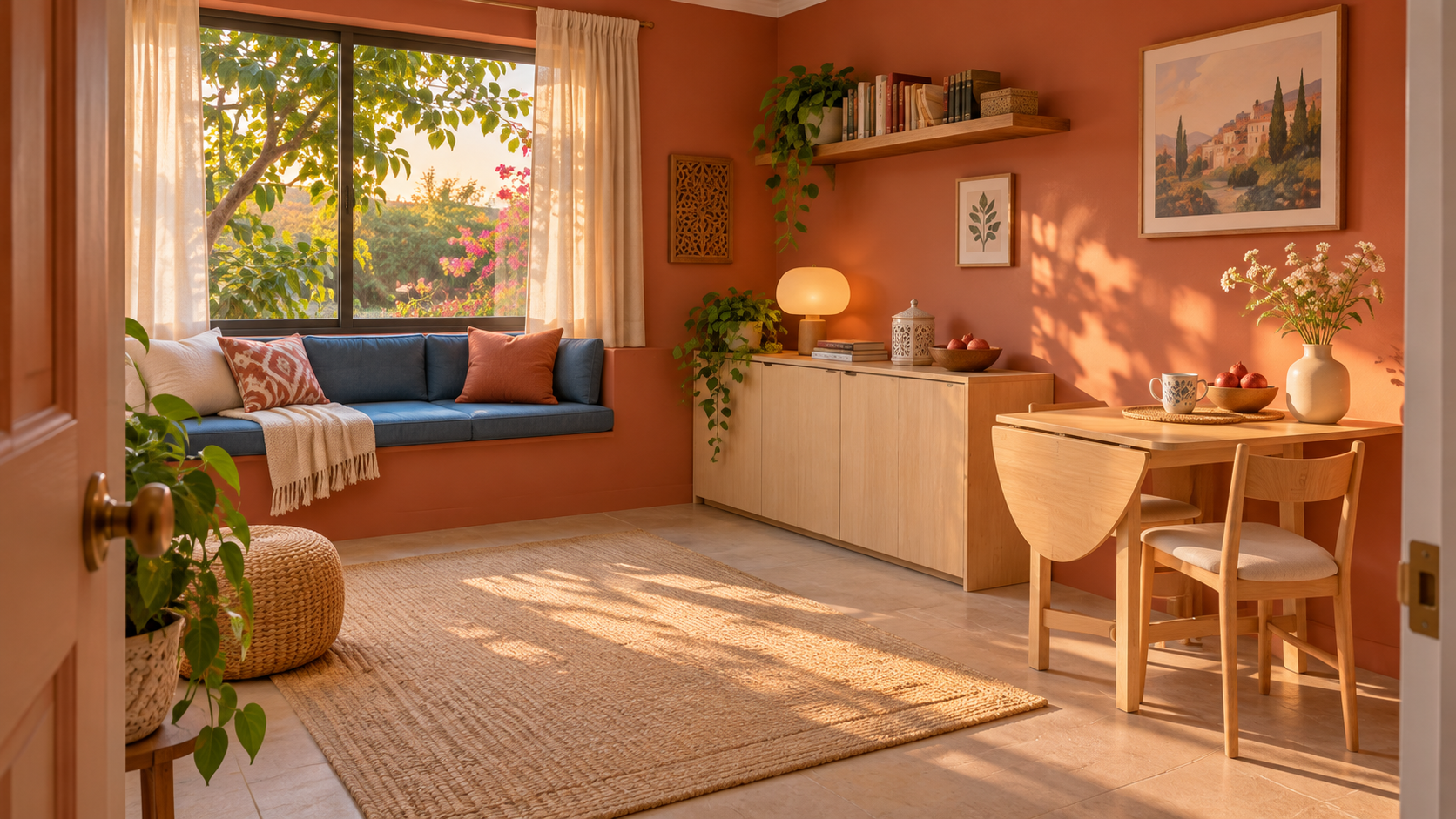
The primary references are linked above. The calculations and decision worksheets are original examples, not field tests. The generated image illustrates layered lighting and a reading area; it does not document measured performance. This content was prepared with AI assistance and has not received independent human editorial review.