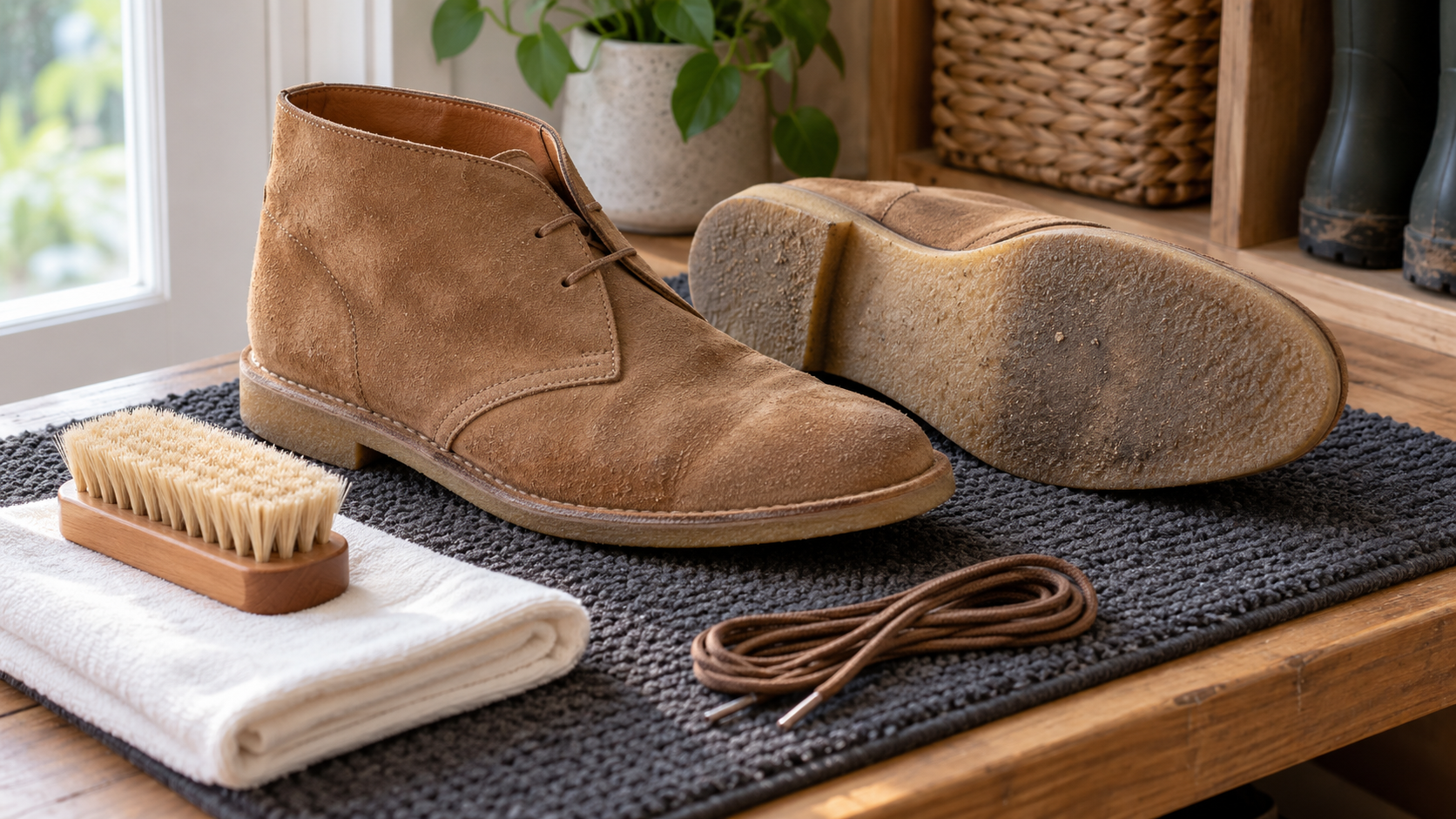
When shoes become dirty, the first question is not “What is the strongest cleaner?” Ask what the material is, what the problem is, and what the model's instructions permit. Surface dust, an unidentified mark, and a separating sole are different situations. Separating them prevents a cosmetic treatment from replacing the action the actual problem needs.
This guide organises everyday shoe care and decisions before using a product. It does not treat a health condition, test cleaners, or guarantee removal of every stain or a like-new result. Examples are fictional, and the manufacturer's instructions for the particular shoes remain the reference for appropriate procedures.
Identify the pair you are handling
Look for the model, materials, and care information on the label or manufacturer's page. Colour alone does not establish material: similar-looking surfaces may have different construction or finishes. If the shoe combines materials, record that instead of treating the entire item as one uniform surface.
A private photograph and instruction link can help without retaining a receipt containing financial details. If the product page has disappeared, ask the manufacturer or a suitable care professional about the material and proposed action. Missing information is a reason to pause guessing, not to try the most popular recipe.
What do the official sources contribute?
The Nike guide describes cleaning steps with material-related precautions.
The Clarks guide separates care for leather, trainers, and suede.
They support reading the appropriate method rather than merging instructions into a universal formula. Model, material, and finish can make an action appropriate for one pair unsuitable for another. Neither source is presented as a purchase recommendation, and instructions for one product should not automatically be transferred to another.
Classify the issue before choosing a tool
Observe the upper, seams, sole, and laces in good light without pulling components apart. Describe what you see: dust, a mark, a visible thread, or a change in shape. Do not infer the cause immediately or label every visible trace as permanent damage.
| Observation | Next question | Do not assume |
|---|---|---|
| Surface dirt | What method is permitted for this material? | The strongest cleaner is best |
| Unknown stain | Is its origin known, and are there relevant instructions? | Mixing products guarantees success |
| Separation or obvious damage | Does it need a repair assessment? | Cleaning restores structural integrity |
| Uncertain material | Who can confirm it? | A photograph is sufficient identification |
Prepare a small, defined task
Decide what this session involves: reading and inspecting, carrying out a permitted care step, or preparing a question for a professional. Everything need not be completed at once. A defined task reduces the temptation to switch between many products when an immediate result does not appear.
Prepare an appropriate surface and clean tools for the job, positioning shoes so dirt is not transferred to unrelated items. Keep products in their original packaging and read instructions and warnings. Do not mix products, transfer them into drink containers, or use an unidentified substance simply because it is already at home.
Choose the method from instructions, not memory
Read both the shoe's care instructions and the care product's directions, then establish compatibility. If they conflict or the material remains unclear, ask before use. “For shoes” on a container does not answer whether it suits every colour, surface, or finish.
If instructions require a limited test, follow the specified location, method, and waiting period. A test is not permission to alter concentration or application time. Likewise, success on an older pair does not establish suitability for a new pair that merely looks similar.
Keep cleaning separate from repair
A cosmetic mark differs from an unstable component or a problem affecting use. If there is separation or damage whose significance you cannot judge, seek an appropriate repair assessment rather than hiding it with polish or improvising glue. This guide does not supply structural repair steps or adhesive selection.
Before handing over a pair, photograph its condition and state the task: stain cleaning, component repair, or an assessment of whether work is worthwhile. Ask about expected results, limitations, and cost. Do not approve colour or finish changes without understanding them. A realistic outcome may be partial improvement rather than complete restoration.
Drying and storage need follow-through
After a permitted treatment, follow the product-specific drying and storage directions. An approaching appointment is not a reason to invent a faster method absent from the instructions. Arrange another pair if you need footwear before the care process can be completed appropriately.
Keep the shoes where their condition can be checked. Do not return them to use or storage merely because one surface looks ready. Detailed times and conditions belong to the manufacturer's guidance; no single duration here is claimed to suit every shoe, home, and climate.
A fictional example involving two pairs
A person has everyday shoes with a textile surface and another pair with a velvety-looking surface of uncertain composition. Both need attention before the following week. The person identifies the models, finds instructions for the first pair, and prepares a supplier question for the second rather than applying one method to both for convenience.
For the first pair, the documented procedure is followed and the product used and observations recorded. Treatment of the second is postponed until its material is confirmed. If inspection reveals a separating sole area, that becomes a separate repair-assessment task, not something removed from the list because the upper looks cleaner.
An alternative pair is selected for the day it is needed, leaving adequate time for care. No guaranteed cleaning result is implied. The example illustrates how information changes the next action instead of making every dirty shoe trigger the same response.
Laces and removable components
Check what is actually removable in the design. Do not pull a fixed-looking part because a video removed something similar from another model. Keep components associated with their own pair so that sizes or arrangements are not accidentally mixed across several shoes.
When ordering a replacement lace or a manufacturer-supported component, record the required length or part reference rather than judging by eye. Not every component is removable, and not every replacement fits every model. A compatibility question is preferable to an unsuitable modification after purchase.
Keep useful records without unnecessary complexity
A short entry for an important pair can contain model, confirmed material, instruction link, last action, and result. Write “complete stain removal was not established” when that is the limit of the observation, rather than “this always works”. Narrow notes help when the issue recurs or professional advice is needed.
Precise wear counts are unnecessary unless they serve a real decision. Link follow-up to observations and manufacturer requirements rather than imposing one general timetable on every pair. Keep care products distinct from medicines and food supplies to avoid confusion.
Before buying another care product
Ask what problem it will address, whether it suits the model, and whether existing appropriate tools already meet the documented need. More containers do not necessarily mean a better plan. The missing step may be a manufacturer or professional question rather than another purchase.
Compare total cost with a realistic goal. Do not add unverified protection, disinfection, or lifespan claims to a product. If a claim matters, request its evidence and scope. This article does not test chemical performance or convert marketing wording into an established fact.
When to stop home experimentation
Pause if the material is unknown, instructions conflict, the surface changes unexpectedly, or the problem appears to require repair. Record what happened and what was used before seeking help. Do not quickly add a second product to conceal the first product's effect.
Pain or a health complaint is a different question from cleaning and cannot be settled here. Odour alone should not be used to diagnose a medical cause or justify mixing substances. Keep the care task clear and seek suitable advice for a different kind of concern.
Ask for precise assistance
Provide the model and a clear image of the material and issue, then state the question. For example: “Is this product suitable for the upper on this model, and what drying instructions apply?” That is more answerable than “How do I make it new again?”
Disclose previous actions honestly, including known products, even if they did not work. Keep the response and date, checking that it concerns your actual shoes rather than generic text. If a provider promises a guaranteed result without understanding the material or condition, ask what that guarantee covers before paying.
Before-start checklist
- Model, material, and instructions are identified, or missing questions are recorded.
- Dirt is distinguished from repair or use-related problems.
- The method and product are compatible according to instructions.
- Tools are clean, containers identified, and no improvised mixtures are involved.
- There is time for follow-through without invented shortcuts.
- Results are recorded with limits rather than universal guarantees.
Sources and transparency
Both sources were read on 1 November 2026. The table, fictional example, and decision workflow are original; no shoe or cleaner was tested. The generated image shows imaginary footwear and care tools, not evidence of a cleaning result. Content was prepared with AI assistance without independent human editorial review.